Instrument air dryer package (twin-tower desiccant)
An instrument air dryer package is a skid that removes water vapour from compressed air before it reaches control valves and instruments. Most are twin-tower desiccant dryers with a pre-filter, an after-filter, switching valves and a controller, and they dry the air to a pressure dew point of about -40 °C. It is often bought apart from the compressor, as modelled here. flow sizes the towers.
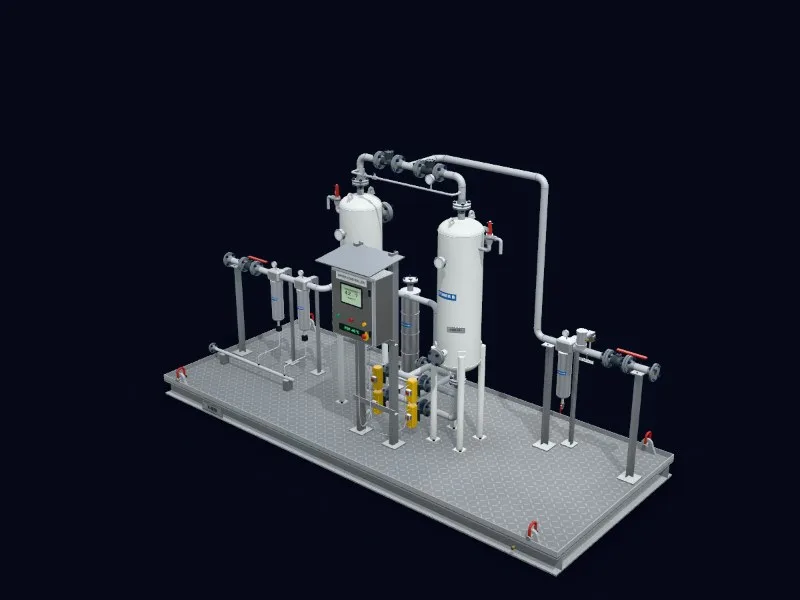
Download this model as a GLB file, with the parameters you set. It opens in Blender, Unity, Unreal, three.js and most 3D viewers. Free for personal use.
Download GLB, free accountInstallation
Installing needs a free account. Run npx decktwin login first.
This command copies packages/instrument-air-dryer.tsx and the shared lib/ into src/components/deck-twin/. It requires three, @react-three/fiber and @react-three/drei. See installation for manual setup.
Usage
import { Canvas } from '@react-three/fiber'
import { OrbitControls } from '@react-three/drei'
import { Stage } from './components/deck-twin/lib/stage'
import { InstrumentAirDryer } from './components/deck-twin/packages/instrument-air-dryer'

export default function Scene() {
  return (
    <Canvas shadows camera={{ position: [8, 5, 9], fov: 35 }}>
      <Stage>
        <InstrumentAirDryer />
      </Stage>
      <OrbitControls makeDefault />
    </Canvas>
  )
}
Props
| Prop | Type | Default | Range |
|---|---|---|---|
flow | number (Nm3/h) | 500 | 100 to 3000 |
towerHeight | number (m) | 1.2 | 0.8 to 3 |
pressure | number (barg) | 13 | 7 to 20 |
inletNps | number (NPS, in) | 2 | |
outletNps | number (NPS, in) | 2 | |
dewPoint | number (°C) | -40 | -70 to -20 |
regen | "heatless" | "heated" | "heatless" | |
tag | string | "X-4650" | |
...group | position, rotation, scale… |
Ports
Flange faces in the component's local coordinate frame, in metres. Origin: centre of the footprint at deck level (y = 0). The plant assembler routes pipework between these ports.
| Id | Label | Position | Direction | Size | Class |
|---|---|---|---|---|---|
inlet | Wet air inlet | -2.374, 1.218, 0.000 | -1, 0, 0 | 2" | 150 |
outlet | Dry instrument air outlet | 2.374, 1.218, -0.416 | 1, 0, 0 | 2" | 150 |
vent | Purge exhaust | -0.470, 1.251, -0.716 | 0, 1, 0 | 2" | 150 |
drain | Filter condensate drain | -2.374, 0.298, 0.300 | -1, 0, 0 | 1" | 150 |
For agents
The machine-readable entry lists props, ranges, defaults and ports:
You can also fetch /r/instrument-air-dryer.json, or copy this instruction:
Add the Deck Twin "Instrument air dryer package (twin-tower desiccant)" component to this project. Run `npx decktwin add instrument-air-dryer` (it copies the file and the shared lib into src/components/deck-twin/). If it answers 401 or says to sign in, run `npx decktwin login`, show me the code it prints, wait while I approve it in the browser, then run the add command again. Then run `npx decktwin info instrument-air-dryer` for its props, ranges and ports. Render <InstrumentAirDryer /> inside a React Three Fiber <Canvas shadows>, wrapped in <Stage> from src/components/deck-twin/lib/stage. Set props from my data (metres, NPS in inches, ASME class) and leave the rest at defaults. Install three, @react-three/fiber, @react-three/drei and @types/three if they're missing. Full guide: https://decktwin.com/skill/SKILL.mdWhat the model shows
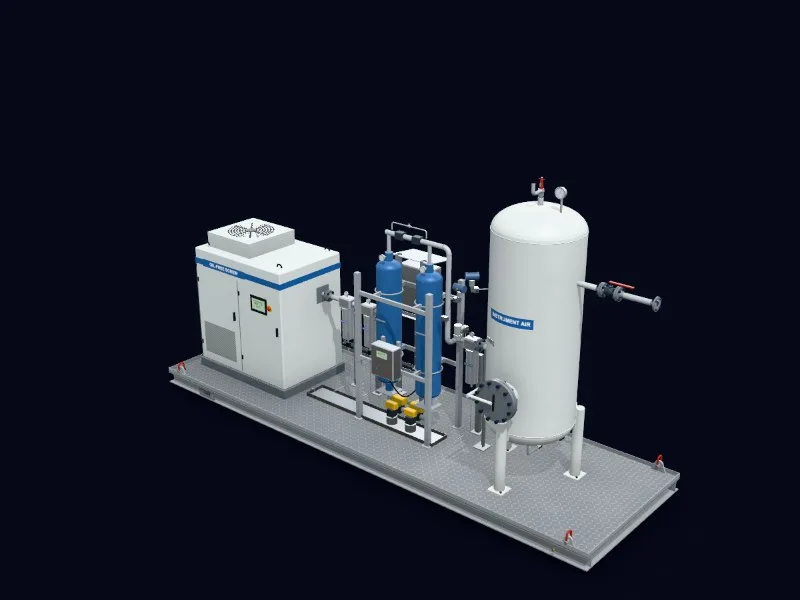
Standalone twin-tower pressure-swing desiccant dryer skid of the kind sold separately from the compressor. Wet air passes an isolation valve, a pre-filter and a coalescer with auto drains piped to a drain header, then pneumatic butterfly switching valves under two ASME VIII towers with fill and drain ports, PSVs, gauges and lifting lugs. Check valves form the outlet manifold, a purge orifice and adjusting valve regenerate the off-line tower through an exhaust silencer, and the dry air leaves through an after-filter and dew-point transmitter; a controller shows the pressure dew point. flow sizes the towers, towerHeight sets their height and regen: heated adds an electric purge heater.
Questions
How does a heatless desiccant dryer work?
Two towers filled with desiccant take turns. One tower dries the compressed air while the other is depressurised, and a small share of the dry air, often around 15 %, flows back through it to strip the moisture and leaves through a silencer. Pneumatic switching valves change over the towers every few minutes. regen: heated adds a purge heater, which cuts the purge air needed.
What dew point does instrument air need?
Offshore instrument air is usually dried to a pressure dew point of -40 °C, which is ISO 8573-1 class 2 for water. ISA-7.0.01 asks for a dew point at least 10 °C below the lowest temperature the air lines will see. dewPoint sets the value shown on the controller and the analyser tag.
Why are there filters before and after the dryer?
The pre-filter and coalescer remove liquid water, oil aerosol and particles that would foul the desiccant, and their auto drains are piped to a drain header. The after-filter catches desiccant dust before the air reaches valves and instruments. A dew-point transmitter at the outlet alarms if the dryer falls behind.
Dryer skid or complete instrument air package?
Large plants often buy compressors, dryers and receivers as separate packages so each can be spared and placed on its own. Smaller units combine them on one skid: see the instrument air package. Suppliers of desiccant dryers include Atlas Copco, Parker (domnick hunter), Hankison, Pneumatech and Ingersoll Rand.
P&ID

Dash-dot package boundary with pre-filter and coalescing filter (diamonds with a dashed element line) ahead of two identical tall towers (capsules, often with desiccant hatching), switching valves at the tower bottoms with a purge exhaust to a silencer, check valves and a purge orifice joining the tower tops, then an after-filter and a dew-point analyser (AT) before the dry instrument-air (IA) outlet.
Two identical towers joined top and bottom by valves, with no compressor or receiver in the boundary, identify a standalone dryer; with a compressor and receiver it is an instrument-air-package. A heater on the purge line marks a heated purge dryer. ISA codes here: AT = dew point; PDI = filter dP.
flowtowerHeightpressureinletNpsoutletNpsdewPointregentagTypical suppliers
Atlas Copco, Parker (domnick hunter), Hankison, Pneumatech, Ingersoll Rand. The geometry is generic and sized to public standards. It is not vendor CAD.