ISO 8573-1
Compressed air: contaminants and purity classes
ISO 8573-1:2010 compressed air purity classes explained: the particle, water and oil table, class 0, reading [1:2:1], and instrument air.
Scope
ISO 8573-1 is the first part of the ISO 8573 series on compressed air. It defines purity classes for the three main contaminants: solid particles, water and oil. The other parts of the series describe how each contaminant is measured.
On oil and gas facilities it is used to specify instrument air and plant air. Instrument air drives control valve actuators, positioners, shutdown valves and purge systems, so it must be dry and free of oil and dirt. A dryer, filters and a receiver after the compressor bring the air to the required class.
It does not size compressors, dryers or receivers, and it does not set the dew point a site needs. That comes from the minimum ambient temperature and the project specification, often with reference to ISA-7.0.01 for instrument air.
ISO 8573 and ISO 8573-1
ISO 8573 is a series of nine parts with the general title Compressed air. When engineers say ISO 8573 they usually mean Part 1, because it sets the purity classes. Parts 2 to 9 are test methods: they say how to measure each contaminant so that a class can be proved.
The current Part 1 is ISO 8573-1:2010, the third edition. It replaced the 2001 edition. ISO has a revision in progress, so check the ISO catalogue before you cite the year.
| Part | What it covers |
|---|---|
| ISO 8573-1 | Contaminants and purity classes |
| ISO 8573-2 | Test methods for oil aerosol content |
| ISO 8573-3 | Test methods for measurement of humidity |
| ISO 8573-4 | Test methods for solid particle content |
| ISO 8573-5 | Test methods for oil vapour and organic solvent content |
| ISO 8573-6 | Test methods for gaseous contaminant content |
| ISO 8573-7 | Test method for viable microbiological contaminant content |
| ISO 8573-8 | Test methods for solid particle content by mass concentration |
| ISO 8573-9 | Test methods for liquid water content |
Part titles as listed in the foreword of ISO 8573-1:2010. Each part has its own edition date.
How to read an ISO 8573-1 class
An air quality is written as the standard, the edition year and three class numbers in a fixed order: particles, water, oil. Suppliers write it as ISO 8573-1:2010 [2:2:1] or ISO 8573-1:2010 class 2.2.1. Both mean the same thing.
A lower number means cleaner air. Each number is chosen on its own, so air can be very dry but only lightly filtered. The class table under Key concepts, further down this page, gives the limits for classes 0 to 4.
- 1
Check the edition
The year after the colon tells you which table applies. Older documents may still cite ISO 8573-1:2001, which the 2010 edition technically revised.
- 2
Read the first number for particles
Classes 1 to 5 count particles per cubic metre in size bands up to 5 µm. Classes 6 and 7 use mass in mg/m³ instead.
- 3
Read the second number for water
Classes 1 to 6 give a pressure dew point, the temperature at which water would condense at line pressure. Classes 7 to 9 limit liquid water in g/m³.
- 4
Read the third number for oil
The oil class limits total oil: aerosol, liquid and vapour together, in mg/m³. Class 1 is 0.01 mg/m³ or less.
- 5
Look for 0, X or a dash
Class 0 must come with its agreed limits in writing. X means the air is worse than the last numbered class. A dash means that contaminant is not specified.
The classes above 4
Most specifications for instrument air stay within classes 1 to 4, which the table under Key concepts covers. The rest of the scale is still useful when you read a supplier datasheet or a test report, because it shows how far air can fall below a target.
Two rules help when you read it. Concentrations are stated at the reference conditions of 20 °C, 1 bar absolute and zero water vapour, so "per m³" means a cubic metre at 20 °C and 1 bar absolute, not at line pressure. And if any particle larger than 5 µm is found, particle classes 1 to 5 cannot be claimed.
| Class | Particles | Water | Oil |
|---|---|---|---|
| 5 | 1 to 5 µm: 100,000 or fewer per m³ | Pressure dew point +7 °C or lower | No class 5 |
| 6 | By mass: up to 5 mg/m³ | Pressure dew point +10 °C or lower | No class 6 |
| 7 | By mass: over 5, up to 10 mg/m³ | Liquid water: up to 0.5 g/m³ | No class 7 |
| 8 | No class 8 | Liquid water: over 0.5, up to 5 g/m³ | No class 8 |
| 9 | No class 9 | Liquid water: over 5, up to 10 g/m³ | No class 9 |
| X | By mass: over 10 mg/m³ | Liquid water: over 10 g/m³ | Total oil: over 5 mg/m³ |
These are the commonly quoted reference values for ISO 8573-1:2010, cross-checked against published compressor and test laboratory tables. They are not a copy of the standard. Confirm them against the current edition before you specify air quality.
Where each contaminant is removed
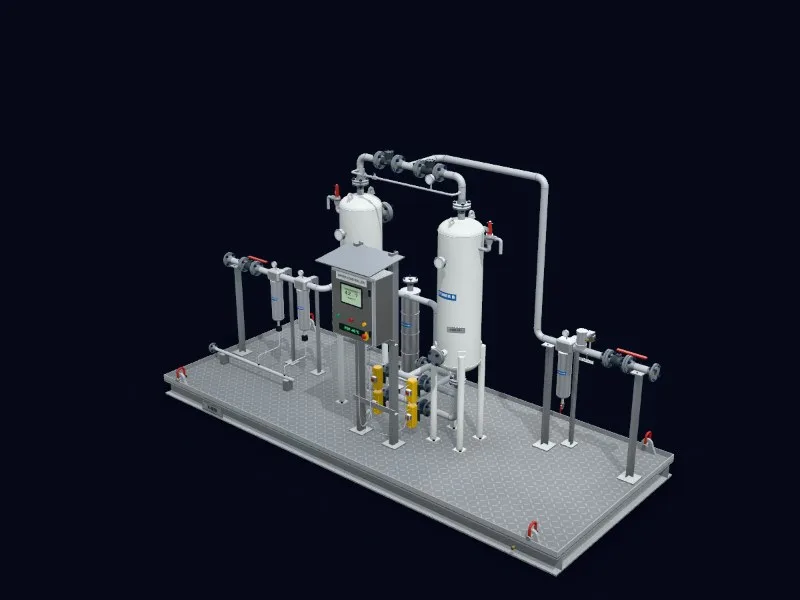
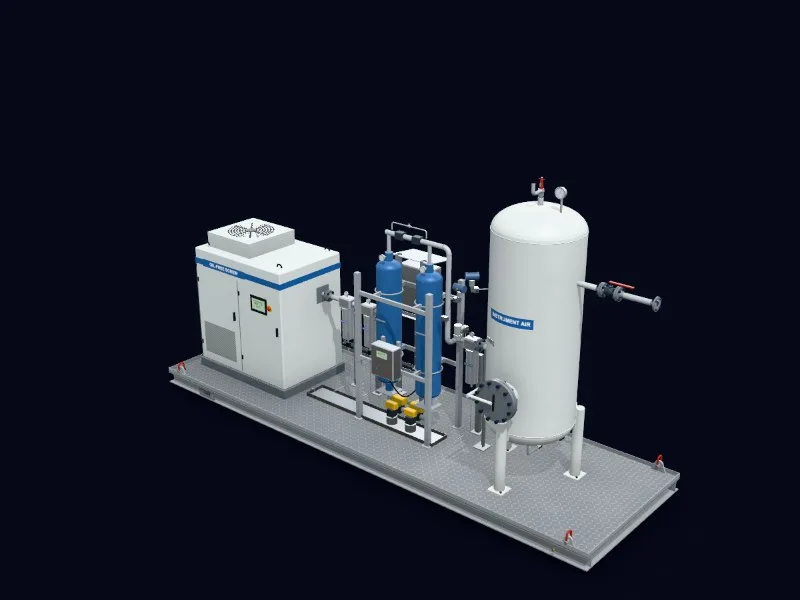
An air class is not made by one machine. Each step in the air treatment train removes one kind of dirt, and the last step decides the class at the outlet. The drawing follows the layout of the instrument air package and the instrument air dryer.
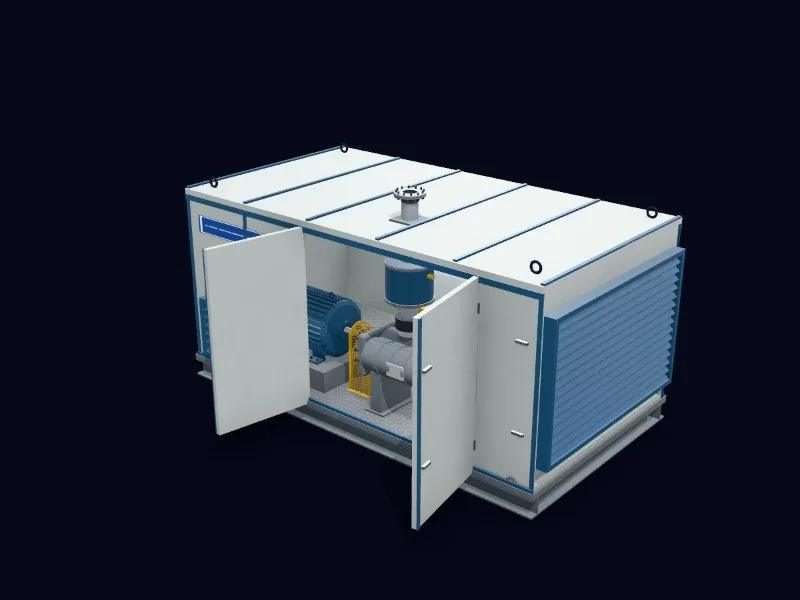
The compressor sets the oil load. An oil-free screw compressor adds no lubricant, so the oil left in the air is what was in the intake. An oil-injected machine needs coalescing filters, and often an activated carbon stage for oil vapour, to reach oil class 1 or 2.
The dryer sets the water class. A refrigeration dryer reaches a pressure dew point of about +3 °C, which is water class 4. A desiccant dryer reaches -40 °C (class 2), and some are built for -70 °C (class 1). The after-filter then catches the desiccant dust that the dryer sheds, which sets the particle class. A dew-point transmitter at the outlet alarms if the dryer falls behind.
The dry air receiver sits after the treatment. It holds enough air to keep valves working for a while after the compressors stop, and it has its own drain.
ISO 8573-1 vs ISA-7.0.01 for instrument air
Instrument air specifications on oil and gas facilities often cite both standards. They do different jobs. ISO 8573-1 is a scale: you pick a class for each contaminant. ANSI/ISA-7.0.01, the quality standard for instrument air, sets fixed limits for air that drives instruments and valves.
| ISO 8573-1 | ISA-7.0.01 | |
|---|---|---|
| What it is | Purity classes for any compressed air | Quality limits for instrument air |
| Water | A dew point class, chosen by the user | Dew point at least 10 °C below the lowest temperature the air system sees, and never above 4 °C at line pressure |
| Particles | Counts by size band, or mass | Largest particle 40 µm |
| Oil | Total oil in mg/m³, by class | Lubricant as close to zero as possible, not above 1 ppm |
| How you use it | Write a class, such as [2:2:1] | Meet the limits, then add a project dew point |
ISA-7.0.01 values are the widely published limits from the 1996 edition. Check the current edition of each standard.
Writing an air quality specification
Offshore, instrument air serves control valves, shutdown valves, positioners and purge systems, so a wet or oily supply can trip the plant. A typical specification states an ISO 8573-1 class and also a dew point in degrees, because the class alone does not tell the vendor the site temperatures.
- 1
Start from the users
List what needs air: valve actuators, positioners, analysers, purged panels. The most sensitive user sets the particle and oil classes.
- 2
Set the dew point from the coldest point
Take the lowest ambient temperature the air lines will see and go at least 10 °C below it. Offshore, -40 °C (water class 2) is a common choice.
- 3
Write the class in full
Write the edition and all three numbers, for example ISO 8573-1:2010 [2:2:1]. If you use class 0, write the agreed limit for that contaminant.
- 4
Say where it applies
Name the point of measurement: the package outlet, the header, or the users. Air that leaves the dryer clean can pick up dirt and water in the distribution piping.
- 5
Ask for proof
Ask the vendor how each class is shown: by the test methods in ISO 8573 Parts 2 to 9, or by filter and dryer ratings. Keep the dew-point transmitter in the alarm list.
Key concepts
- Purity class notation
- Air quality is written as three class numbers in the order particles, water, oil, for example ISO 8573-1 class 1.2.1. A lower number means cleaner air. Each contaminant can be specified separately.
- Class 0
- Class 0 is not a fixed limit. It means a quality stricter than class 1 that the user or supplier specifies. It is often quoted for oil-free compressors.
- Water and pressure dew point
- Water classes for vapour are set by pressure dew point, the temperature at which water would condense at line pressure. Instrument air is commonly dried to a dew point well below the lowest ambient, for example around -40 °C.
- Particles
- Particle classes count particles by size band in a volume of air. Filters after the dryer catch desiccant dust so that the air meets the particle class at the point of use.
- Oil
- Oil covers aerosol, liquid and vapour. Oil-free compressors or coalescing filters with activated carbon keep oil out of instruments and analysers.
- Point of measurement
- A class applies where it is measured. Air that leaves the dryer at class 1.2.1 can pick up dirt or water in the distribution header, so quality is often checked at the users as well.
| Class | Particles, max per m³ | Water, pressure dew point | Total oil |
|---|---|---|---|
| 0 | As agreed, stricter than class 1 | As agreed, stricter than class 1 | As agreed, stricter than class 1 |
| 1 | 20,000 / 400 / 10 | -70 °C or lower | 0.01 mg/m³ or less |
| 2 | 400,000 / 6,000 / 100 | -40 °C or lower | 0.1 mg/m³ or less |
| 3 | not set / 90,000 / 1,000 | -20 °C or lower | 1 mg/m³ or less |
| 4 | not set / not set / 10,000 | +3 °C or lower | 5 mg/m³ or less |
Particle counts are for the size bands 0.1 to 0.5 µm, 0.5 to 1 µm and 1 to 5 µm. Total oil is aerosol, liquid and vapour together. Higher classes are less strict: water classes 5 and 6 have dew points of +7 °C and +10 °C. These are the widely published headline limits. Check the standard before you specify air quality.
Questions
What is ISO 8573-1 class 0?
Class 0 has no fixed limit. It means a purity that is stricter than class 1 and that the user or supplier states in writing, with the measured values. It is often quoted for oil-free compressors. A class 0 claim should always come with the contaminant it applies to and the agreed limit.
What does ISO 8573-1 class 1.2.1 mean?
The three numbers are the classes for particles, water and oil, in that order. Class 1.2.1 means particle class 1, a pressure dew point of -40 °C or lower, and total oil of 0.01 mg/m³ or less. It is a common way to write a dry, oil-free air quality.
What are ISO 8573-1 class 1, class 2 and class 4?
A class number has a meaning only for a named contaminant. For water, class 1 is a pressure dew point of -70 °C, class 2 is -40 °C and class 4 is +3 °C, which is what a refrigeration dryer reaches. For oil, class 1 is 0.01 mg/m³, class 2 is 0.1 mg/m³ and class 4 is 5 mg/m³. The table above also gives the particle limits.
Which ISO 8573-1 class is used for instrument air?
The standard does not choose a class for any use. The project specification does. Instrument air on oil and gas facilities is commonly dried to water class 2 (-40 °C) or better, with a dew point at least 10 °C below the lowest ambient temperature, and with low particle and oil classes. See the instrument air package and the instrument air dryer.
What is the current edition of ISO 8573-1?
ISO 8573-1:2010 is the current edition. ISO lists a revision under development, so check the ISO catalogue for a newer one.
What is the difference between ISO 8573 and ISO 8573-1?
ISO 8573 is the whole series on compressed air, in nine parts. ISO 8573-1 is Part 1, which sets the purity classes for particles, water and oil. Parts 2 to 9 give the test methods used to measure each contaminant.
What does class X mean in ISO 8573-1?
X means the air is worse than the last numbered class for that contaminant. For particles it means more than 10 mg/m³, for water more than 10 g/m³ of liquid water, and for oil more than 5 mg/m³. It describes air as found, not a quality anyone would specify.
Is ISO 8573-1 the same as ISA-7.0.01?
No. ISO 8573-1 is a class scale for any compressed air. ISA-7.0.01 sets fixed limits for instrument air: a dew point at least 10 °C below the lowest ambient, particles no larger than 40 µm and almost no oil. Instrument air specifications often cite both.
In Deck Twin
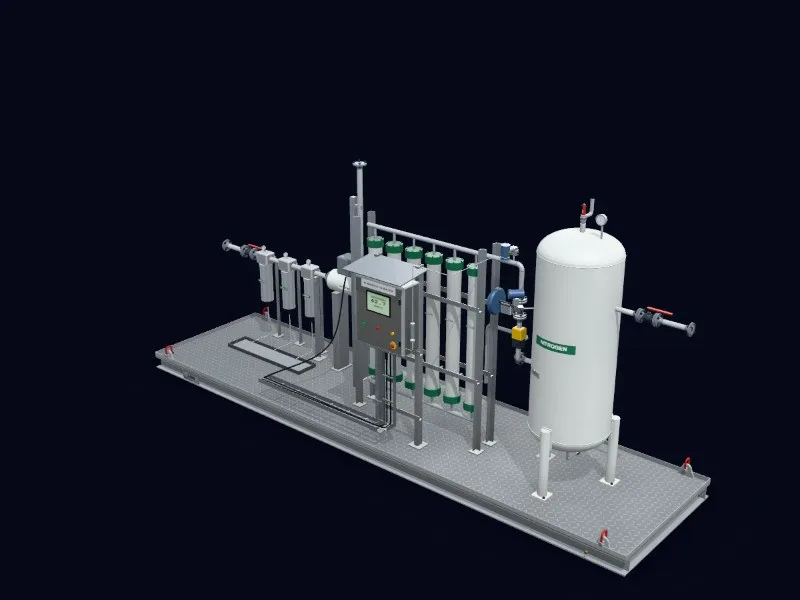
The air treatment trains in the instrument air package and the instrument air dryer follow the usual layout for reaching an ISO 8573-1 class: pre-filter and coalescer, twin-tower desiccant dryer, after-filter and dew-point transmitter. The screw compressor and the nitrogen generator cite it for their air quality. There is no lib/standards function for it, because the standard sets air quality rather than dimensions.
Deck Twin uses these standards as reference values for visualisation. Check the current edition of each standard before using any value for design, procurement or fabrication.