Lightning mast (lightning protection mast)
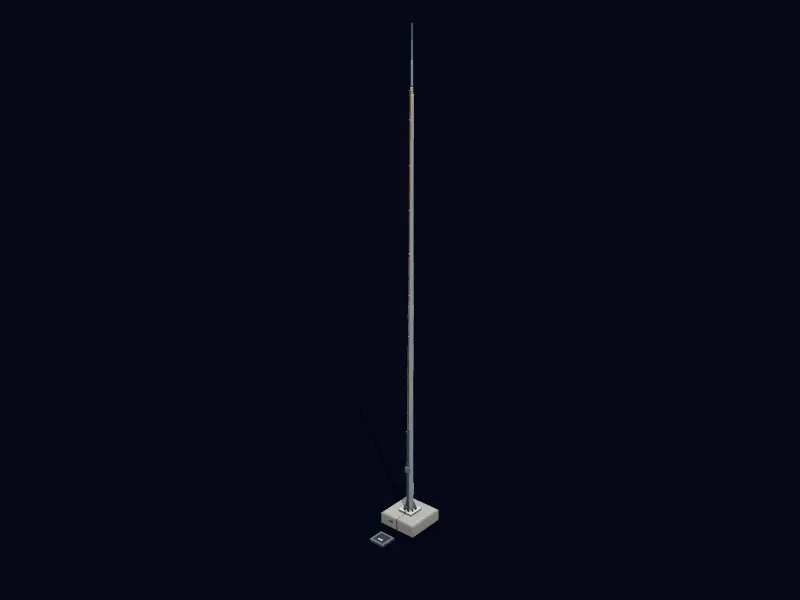
A free-standing mast with an air-termination rod at the top, a down conductor and an earth electrode. It intercepts lightning strikes and carries the current safely to earth, so that tanks, substations, loading areas and process plant inside its protected zone are not struck. It is different from a lighting mast, which carries floodlights.
Download this model as a GLB file, with the parameters you set. It opens in Blender, Unity, Unreal, three.js and most 3D viewers. Free for personal use.
Download GLB, free accountInstallation
Installing needs a free account. Run npx decktwin login first.
This command copies electrical/lightning-protection-mast.tsx and the shared lib/ into src/components/deck-twin/. It requires three, @react-three/fiber and @react-three/drei. See installation for manual setup.
Usage
import { Canvas } from '@react-three/fiber'
import { OrbitControls } from '@react-three/drei'
import { Stage } from './components/deck-twin/lib/stage'
import { LightningProtectionMast } from './components/deck-twin/electrical/lightning-protection-mast'

export default function Scene() {
  return (
    <Canvas shadows camera={{ position: [8, 5, 9], fov: 35 }}>
      <Stage>
        <LightningProtectionMast />
      </Stage>
      <OrbitControls makeDefault />
    </Canvas>
  )
}
Props
| Prop | Type | Default | Range |
|---|---|---|---|
height | number (m) | 20 | 6 to 40 |
style | "tubular" | "lattice" | "tubular" | |
lpl | "I" | "II" | "III" | "IV" | "II" | |
zone | boolean | false | |
conductor | "copper" | "aluminium" | "copper" | |
obstructionLight | boolean | false | |
tag | string | "LPM-101" | |
...group | position, rotation, scale… |
For agents
The machine-readable entry lists props, ranges, defaults and ports:
You can also fetch /r/lightning-protection-mast.json, or copy this instruction:
Add the Deck Twin "Lightning mast (lightning protection mast)" component to this project. Run `npx decktwin add lightning-protection-mast` (it copies the file and the shared lib into src/components/deck-twin/). If it answers 401 or says to sign in, run `npx decktwin login`, show me the code it prints, wait while I approve it in the browser, then run the add command again. Then run `npx decktwin info lightning-protection-mast` for its props, ranges and ports. Render <LightningProtectionMast /> inside a React Three Fiber <Canvas shadows>, wrapped in <Stage> from src/components/deck-twin/lib/stage. Set props from my data (metres, NPS in inches, ASME class) and leave the rest at defaults. Install three, @react-three/fiber, @react-three/drei and @types/three if they're missing. Full guide: https://decktwin.com/skill/SKILL.mdWhat the model shows
Free-standing air-termination mast for shielding tank farms, substations and loading areas, either a tapered galvanised tube with slip joints or a tapered angle lattice with a pole top. It stands on a concrete pad with grout, base plate and anchor bolts, carries a stepped air rod, and has a clipped copper or aluminium tape down conductor, a test joint box at 1.5 m, a conductor guard over the bottom run and an earth inspection pit beside the base. zone shows the rolling-sphere protected volume for the chosen lpl (sphere radius 20, 30, 45 or 60 m), which stops at the sphere radius on masts taller than it (a ring on the mast marks that height, above which the mast is open to side flashes), and obstructionLight adds an aviation red light. This is a lightning protection mast, not the area floodlighting lighting-mast.
Questions
How is the protected zone worked out?
IEC 62305-3 uses the rolling sphere method. A sphere of radius 20, 30, 45 or 60 m, for lightning protection levels I to IV, is rolled over the structure and the ground, and anything the sphere cannot touch is protected. Set lpl and switch on zone to see the protected volume around the mast.
What are the parts at the base?
The down conductor runs in clips down the mast to a test joint about 1.5 m above grade, where it can be disconnected to measure earth resistance. A guard covers the conductor near the ground, and the conductor ends in an earth electrode inside an inspection pit with a marked cover. Components follow the EN 62561 series.
Who makes lightning protection masts?
Suppliers of masts and lightning protection components include DEHN, nVent ERICO and ABB (Furse). Mast height, foundation and conductor material come from the lightning risk assessment and the site's wind loading.
P&ID

On earthing and lightning protection layouts: the mast base as a small square or circle at its plot position, an arrow or zig-zag flash marking the air terminal, the down conductor running to an earth pit (an earth symbol or a square marked E or EP), and a dashed circle for the protected radius at grade with the rod height and LPL noted.
Layout-only: lightning masts and their earthing are not shown on P&IDs. The dashed protection circle on the plan is the rolling-sphere (or protective-angle) radius at the reference plane, so check the LPL and height in the drawing notes. A circle with a cross is a floodlight (lighting-mast), not an air terminal.
heightstylelplconductorobstructionLighttagTypical suppliers
DEHN, ABB (Furse), nVent ERICO. The geometry is generic and sized to public standards. It is not vendor CAD.