Vent boom (cold vent)
A vent boom is a steel boom that carries a cold vent line out from the edge of an offshore platform, so that released gas disperses well away from the deck, air intakes and people. Platforms that vent rather than flare, or that need a cold vent for blowdown or low-pressure gas, use one. There is no flame in normal service.
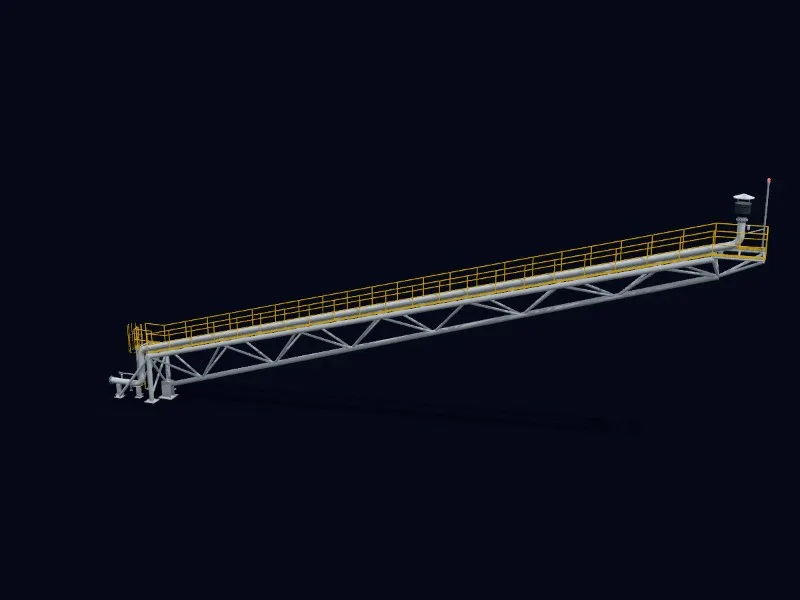
Download this model as a GLB file, with the parameters you set. It opens in Blender, Unity, Unreal, three.js and most 3D viewers. Free for personal use.
Download GLB, free accountInstallation
Installing needs a free account. Run npx decktwin login first.
This command copies thermal/vent-boom.tsx and the shared lib/ into src/components/deck-twin/. It requires three, @react-three/fiber and @react-three/drei. See installation for manual setup.
Usage
import { Canvas } from '@react-three/fiber'
import { OrbitControls } from '@react-three/drei'
import { Stage } from './components/deck-twin/lib/stage'
import { VentBoom } from './components/deck-twin/thermal/vent-boom'

export default function Scene() {
  return (
    <Canvas shadows camera={{ position: [8, 5, 9], fov: 35 }}>
      <Stage>
        <VentBoom />
      </Stage>
      <OrbitControls makeDefault />
    </Canvas>
  )
}
Props
| Prop | Type | Default | Range |
|---|---|---|---|
length | number (m) | 30 | 10 to 120 |
angle | number (°) | 15 | 0 to 45 |
nps | number (NPS, in) | 12 | |
rating | 150 | 300 | 600 | 900 | 1500 | 2500 | 150 | |
arrestor | boolean | true | |
walkway | boolean | true | |
tag | string | "VS-A400" | |
...group | position, rotation, scale… |
Ports
Flange faces in the component's local coordinate frame, in metres. Origin: centre of the footprint at deck level (y = 0). The plant assembler routes pipework between these ports.
| Id | Label | Position | Direction | Size | Class |
|---|---|---|---|---|---|
inlet | Vent header inlet | -3.249, 0.800, 0.588 | -1, 0, 0 | 12" | 150 |
purge | Nitrogen purge | -2.549, 1.212, 0.588 | 0, 1, 0 | 2" | 150 |
drain | Low-point drain | -1.999, 0.338, 0.588 | 0, -1, 0 | 2" | 150 |
snuffing | Snuffing (CO2 / N2) | -2.849, 1.200, 0.366 | -1, 0, 0 | 2" | 150 |
For agents
The machine-readable entry lists props, ranges, defaults and ports:
You can also fetch /r/vent-boom.json, or copy this instruction:
Add the Deck Twin "Vent boom (cold vent)" component to this project. Run `npx decktwin add vent-boom` (it copies the file and the shared lib into src/components/deck-twin/). If it answers 401 or says to sign in, run `npx decktwin login`, show me the code it prints, wait while I approve it in the browser, then run the add command again. Then run `npx decktwin info vent-boom` for its props, ranges and ports. Render <VentBoom /> inside a React Three Fiber <Canvas shadows>, wrapped in <Stage> from src/components/deck-twin/lib/stage. Set props from my data (metres, NPS in inches, ASME class) and leave the rest at defaults. Install three, @react-three/fiber, @react-three/drei and @types/three if they're missing. Full guide: https://decktwin.com/skill/SKILL.mdWhat the model shows
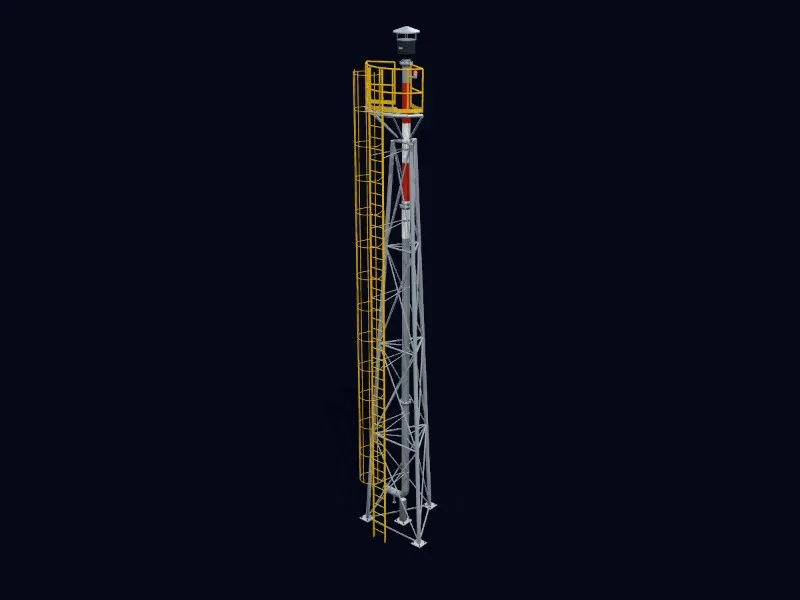
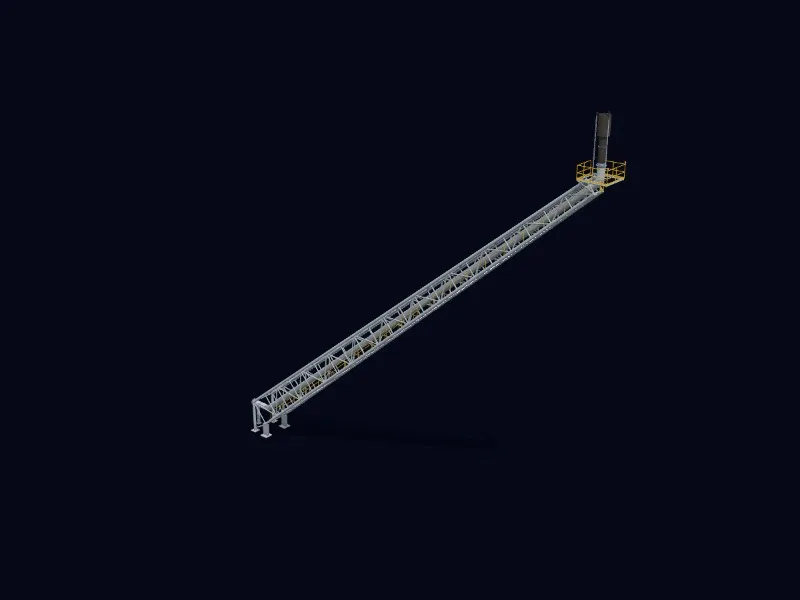
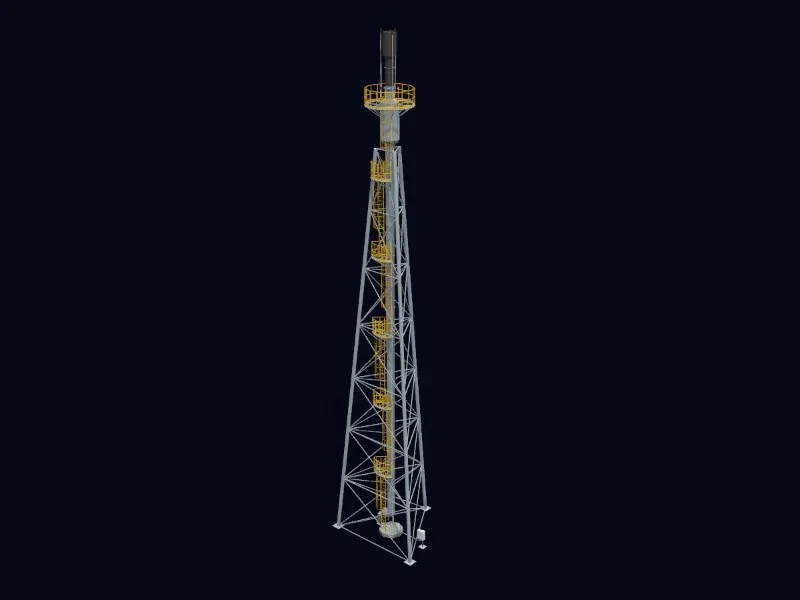
Offshore cold vent boom: an inclined lattice boom pinned at the deck edge that carries the vent line out to a vertical tip, with an end-of-line deflagration arrester or a plain velocity tip. It has a flanged vent inlet, a low-point drain, a nitrogen purge, a snuffing line to the tip, an ISO 14122 walkway from a root landing to a tip platform, and an obstruction light. Unlike the flare boom it has no flare tip, pilots or flame, and unlike the vent stack it cantilevers off the platform edge. length, angle, nps, arrestor and walkway matter most.
Questions
How is a vent boom different from a flare boom?
A flare boom burns the gas at a flare tip with pilots and an ignition system, and its length is set by heat radiation. A vent boom releases the gas unburnt through a vent tip, often with a flame arrester, and its length is set by dispersion, so that the gas cloud stays below its lower flammable limit at places people can reach. API 521 covers both. A vent stack does the same job as a vertical stack on the deck.
What if the vent ignites?
A vent can be ignited by lightning or static. Thermocouples at the tip detect a flame, and a snuffing line injects nitrogen or CO2 to put it out. A nitrogen purge keeps air out of the vent line, and a low-point drain removes liquid.
How long is a vent boom?
Dispersion studies set the length, typically 15 to 60 m, and some large platforms have booms over 100 m. Set length and angle to match, nps for the vent line, and walkway for the access walkway and tip platform used for maintenance.
P&ID

On the vent P&ID: the cold vent header ending at an open vent tip with an arrow or "TO ATM", often with a flame arrester (box with parallel lines) at the tip, a nitrogen purge tie-in and a low-point drain at the base; on layouts an inclined boom outline running out from the platform edge to the tip.
No flame symbol and no pilot or ignition lines: a cold vent, not a flare boom. A vertical stack standing on the deck is a vent-stack; a boom cantilevered off the deck edge is this vent-boom.
lengthanglenpsratingarrestorwalkwaytagTypical suppliers
Zeeco, Argo Flares, Heerema Fabrication Group (fabricator). The geometry is generic and sized to public standards. It is not vendor CAD.