ASME B36.10 / B36.19
Welded and seamless wrought steel pipe, and welded and seamless wrought stainless steel pipe
ASME B36.10 and B36.19 pipe sizes and schedules: NPS, outside diameter, wall thickness, STD, XS and S schedules, with library pipe functions.
Scope
ASME B36.10 sets the outside diameters and wall thicknesses of welded and seamless wrought steel pipe, mainly carbon and low-alloy steel. ASME B36.19 does the same for stainless steel pipe, with its own light-wall S schedules. The 2022 editions, B36.10-2022 and B36.19-2022, dropped the M. Editions up to 2018 carried it, as in B36.10M-2018 and B36.19M-2018, and older specifications cite them that way.
Every line on an oil and gas plant is specified by NPS and schedule from these standards. Line lists, piping classes, isometrics and stress models all start from B36.10 or B36.19 dimensions.
These standards set dimensions only. Material, manufacture and testing come from material specifications such as ASTM A106, API 5L or ASTM A312. Pressure design comes from the piping code, such as ASME B31.3 or B31.8.
Key concepts
- Nominal pipe size
- NPS is a size designation, not a measured diameter. Up to NPS 12 the outside diameter is larger than the NPS; from NPS 14 upward the outside diameter in inches equals the NPS. For example, NPS 6 pipe has an outside diameter of 168.3 mm.
- Fixed outside diameter
- For each NPS the outside diameter is the same for every schedule. A heavier schedule has a thicker wall and a smaller bore. This keeps fittings and flanges compatible across schedules.
- Schedule numbers
- B36.10 schedule numbers run from 5 to 160. Not every schedule is defined for every size. Schedule 40 and 80 are the most common in process piping.
- STD, XS and XXS
- Standard (STD), extra strong (XS) and double extra strong (XXS) are weight designations. STD matches Schedule 40 up to NPS 10, and XS matches Schedule 80 up to NPS 8. Above those sizes they differ.
- Stainless S schedules
- B36.19 adds Schedules 5S, 10S, 40S and 80S for stainless pipe. Light walls such as 10S are common for stainless utility and seawater systems.
- DN equivalents
- Metric drawings use DN, the nominal diameter in millimetres, for example DN 150 for NPS 6. The pipe dimensions are the same.
Questions
What is the difference between ASME B36.10 and B36.19?
B36.10 covers carbon and alloy steel pipe, and B36.19 covers stainless steel pipe. The outside diameters are the same. B36.19 adds thin-wall schedules with an S suffix, such as 5S and 10S, which corrosion-resistant pipe can use because it needs little or no corrosion allowance.
Is Schedule 40S the same as Schedule 40?
Up to NPS 10 the wall thickness is the same. From NPS 12 upward, Schedule 40S stays at 9.53 mm while Schedule 40 keeps getting thicker. Schedule 80S and Schedule 80 differ in the same way above NPS 8.
In Deck Twin
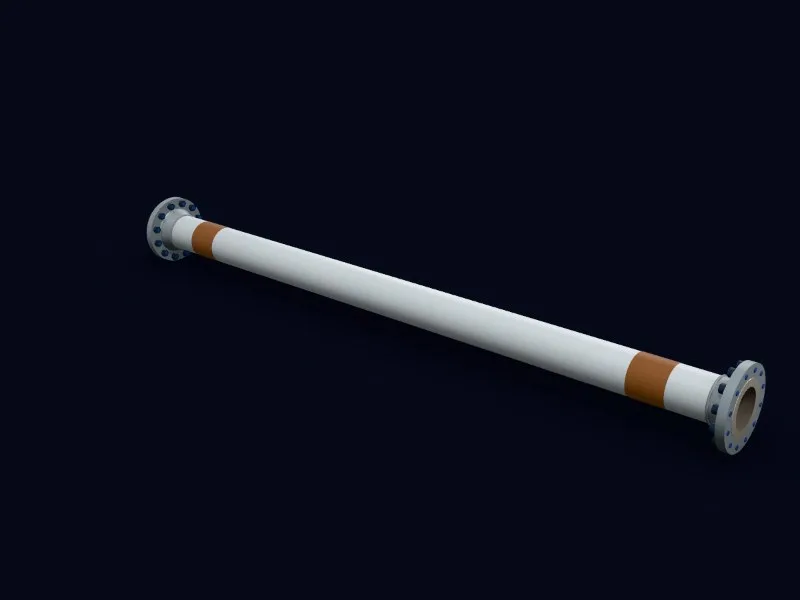
pipeOD(nps), pipeWall(nps, schedule), pipeID, pipeMass and dn return B36.10 and B36.19 values in metres (mass in kg/m) for NPS 1/8 to 48 and schedules 5S to XXS. If a schedule is not defined for a size, pipeWall falls back to the nearest heavier defined wall. Every component with a schedule prop uses these values, including the pipe spool, elbow, weld-neck flange and slug catcher.
import { pipeOD, pipeWall, pipeID, dn } from './components/deck-twin/lib/standards'

pipeOD(6)          // 0.1683
pipeWall(6, '40')  // 0.0071
pipeID(6, '40')    // 0.1541
dn(6)              // 150
Deck Twin uses these standards as reference values for visualisation. Check the current edition of each standard before using any value for design, procurement or fabrication.