P&ID line types and signal line symbols
Lines on a P&ID fall into two families. Process lines are heavy and carry a line number: they are the pipes. Instrument lines are thin and carry a signal or a connection, and the mark repeated along them says which kind. The signal line types come from ISA 5.1.
16 symbols. Company legends vary, so the legend sheet of the drawing you are reading comes first.
How to read these symbols
Process lines
A heavy solid line is a main process line, and a medium line is a secondary or utility line. The line number along it usually gives size, service, sequence number, piping class and insulation, for example 8"-PG-1101-D6A-N, though the order differs by company. On many legends a heavy line of long dashes is a future line, a screened grey line is existing plant, and hatch marks along a line mean it is to be removed.
Signal lines
A thin solid line connects an instrument to the process or to a supply. Pairs of short slashes (//) mean a pneumatic signal and a thin dashed line an electric one. Small L marks are hydraulic and × marks a filled capillary. Small open circles are a software or data link. Wave marks are an electromagnetic or sonic signal: drawn on a line when the signal is guided, and on their own when it is not, as with radio.
Lines with a second line beside them
In this library a heat-traced line is a heavy process line with a thin dashed line running alongside. A jacketed line has a thin outer line on both sides, closed at the ends, for a pipe inside a pipe. Read each as one pipe with an extra service, not as two lines.
When the legend disagrees
Company legends and older drawings do not always use the current ISA 5.1 line types. On a legacy drawing, check the legend sheet before reading // as instrument air or a dashed line as an electric signal.
All 16 symbols


Download the legend sheet (SVG)Whole legend (SVG)
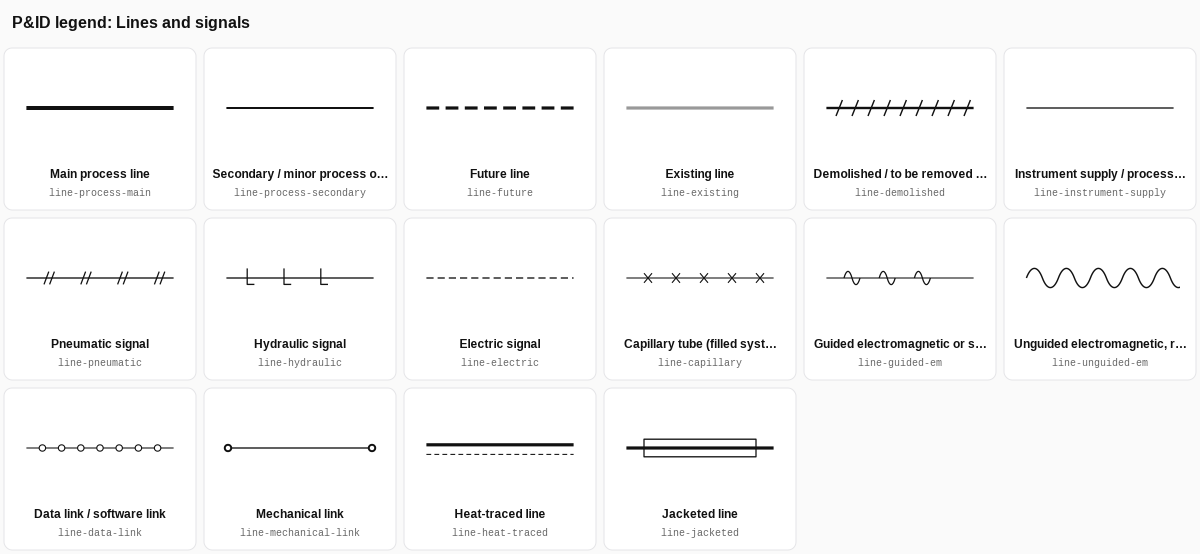

How each symbol is drawn
| Symbol | Drawn as | Tags |
|---|---|---|
| Main process line | A heavy (thick) solid line, with a line number written along it (e.g. 8"-PG-1101-D6A-N). | |
| Secondary / minor process or utility line | A medium-weight solid line, thinner than main process lines, with its own line number. | |
| Future line | A heavy line made of long dashes, often marked "FUTURE". | |
| Existing line | A screened (gray or lighter) line, sometimes labelled "EXISTING" or with a note, on brownfield drawings. | |
| Demolished / to be removed line | A line with short diagonal hatch marks (or crosses) along it, often labelled "TO BE REMOVED" or "DEMOLISH". | |
| Instrument supply / process connection | A thin solid line from a process line or vessel to an instrument bubble (or from a supply header). | |
| Pneumatic signal | A thin line with pairs of short diagonal slashes (//) at intervals. | |
| Hydraulic signal | A thin line with small "L" marks at intervals. | |
| Electric signal | A thin dashed line. | |
| Capillary tube (filled system) | A thin line with small × marks at intervals. | |
| Guided electromagnetic or sonic signal | A thin solid line with small sine-wave marks on it at intervals. | |
| Unguided electromagnetic, radio or sonic signal | A free sine wave with no straight line under it. | |
| Data link / software link | A thin line with small open circles on it at intervals. | |
| Mechanical link | A thin line with a small open circle at each end (pivots). | |
| Heat-traced line | A heavy process line with a thin dashed line running alongside it. | |
| Jacketed line | A heavy process line with a thin outer line on both sides, closed at the ends (a pipe inside a pipe). |
Questions
What does a dashed line mean on a P&ID?
A thin dashed line is usually an electric instrument signal under ISA 5.1. A heavy line of long dashes is different: on many legends it marks a future process line. Check the line weight first.
What does a line with two slashes mean on a P&ID?
A pneumatic signal, such as air from an I/P converter or positioner to a valve actuator. See the pneumatic signal line.
What is the difference between a main and a secondary process line?
Only the line weight. A main process line is drawn heavy, and a secondary line for minor process or utility piping is drawn thinner. Both carry their own line numbers.
What does a line with small circles mean on a P&ID?
A software or data link between systems, such as a link between the DCS and a package controller, or between two control functions in the same system. See the data link symbol.
How do you read a P&ID line number?
A common order is size, service code, sequence number, piping class and insulation code, as in 8"-PG-1101-D6A-N: an 8 inch process gas line, number 1101, class D6A, not insulated. The order and codes differ by company, so the legend sheet defines them.
Other symbol categories
- Valves 23
- Check valves 6
- Relief, regulators and safety devices 9
- Actuators, operators and valve accessories 25
- Piping fittings and specials 37
- Connectors, boundaries and annotations 11
- Instrument bubbles and functions (ISA 5.1) 14
- Primary elements and field instruments 30
- Vessels, columns and tanks 13
- Heat transfer equipment 12
- Pumps 9
- Compressors, blowers and drivers 15
- Filters, separators and mixers 10
- Flare, wellhead, pipeline and packages 16
- Fire & gas and fire protection 24
- Electrical (single-line) 23