Relief valve and PSV symbols on a P&ID
Relief valves, rupture discs and regulators act on the process with no control system behind them. Relief valves and rupture discs open on overpressure. Regulators hold a pressure or a temperature by themselves. On most legends a relief valve has an angle body, inlet from below and outlet to the side, and a regulator has a straight body with a diaphragm dome and a sensing line.
9 symbols.
How to read these symbols
Reading a PSV
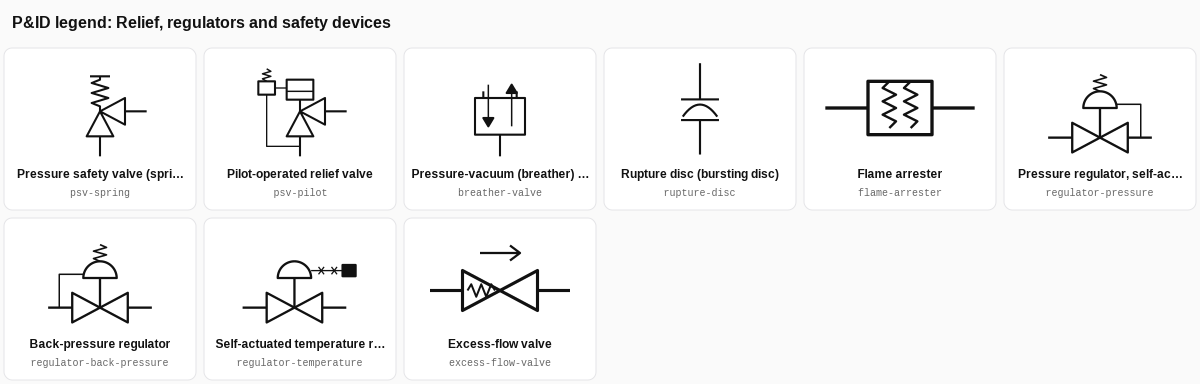
A spring-loaded PSV is an angle body with a spring on top, drawn here as a zig-zag. The pilot-operated valve on this page replaces the spring with a box and adds a small pilot with a sensing line back to the inlet. The tag beside it usually gives the set pressure and a size such as 3L4: a 3 inch inlet, an L orifice and a 4 inch outlet. The orifice letters, D to T, are listed in API 526.
Rupture discs and other passive devices
These shapes vary from legend to legend. On this page a rupture disc is two short bars across a pipe with an arc between them bulging towards the outlet, and its ISA tag is PSE, pressure safety element. A flame arrester is an in-line box with zig-zag lines inside. A breather valve on a tank nozzle shows two arrows: one up for pressure relief and one down for vacuum relief.
Regulators: follow the sensing line
A pressure regulator (PCV) has a dome on its stem and a thin sensing line to the pipe. When the line taps downstream of the valve it holds downstream pressure. When it taps upstream it is a back-pressure regulator. A temperature regulator (TCV) has a capillary, a line with small × marks, running to a sensing bulb. None of them has a separate controller bubble. Some legends also use PCV and TCV for valves driven by a controller, so check for a controller in the loop.
Where the relief goes
Follow the outlet line. Hydrocarbon reliefs usually discharge into a flare header, and flare and relief systems are designed to API 521. Small thermal relief valves (TSV) and utility reliefs may vent to atmosphere or to a drain.
All 9 symbols


Download the legend sheet (SVG)Whole legend (SVG)
How each symbol is drawn
| Symbol | Drawn as | Tags |
|---|---|---|
| Pressure safety valve (spring loaded) | An angle body with the inlet from below and the outlet to the side, and a zig-zag spring on top capped by a short bar. A PSV bubble with the loop number usually sits beside it (not drawn here), with the set pressure and the orifice size (e.g. "3L4"). | PSV, PRV, TSV, SV |
| Pilot-operated relief valve | An angle relief body with a piston chamber (a box) on top instead of a spring, and a small spring-loaded pilot beside it with a sensing line back to the inlet. | PSV |
| Pressure-vacuum (breather) valve | A housing on a tank nozzle with two arrows inside: one pointing up (pressure relief out) and one pointing down (vacuum relief in), each over a weighted pallet. | PVRV, PSV |
| Rupture disc (bursting disc) | Two short parallel bars (the holder) across a vertical pipe, with a curved arc between them bulging towards the outlet. | PSE, RD, BD |
| Flame arrester | An in-line rectangle on the pipe with zig-zag lines inside (the crimped-metal element). | FA |
| Pressure regulator, self-actuated (PCV) | A bow-tie body with a diaphragm dome on its stem, a spring above the dome, and a thin sensing line from the dome to the pipe downstream of the valve. | PCV |
| Back-pressure regulator | Like the pressure regulator, but the thin sensing line runs from the dome to the pipe upstream of the valve. | PCV, BPR |
| Self-actuated temperature regulator | A bow-tie body with a diaphragm dome, and a capillary (line with small × marks) running from the dome to a sensing bulb. | TCV |
| Excess-flow valve | A bow-tie with a spring drawn inside the inlet triangle and a flow arrow above. | EFV |
3D components for these symbols
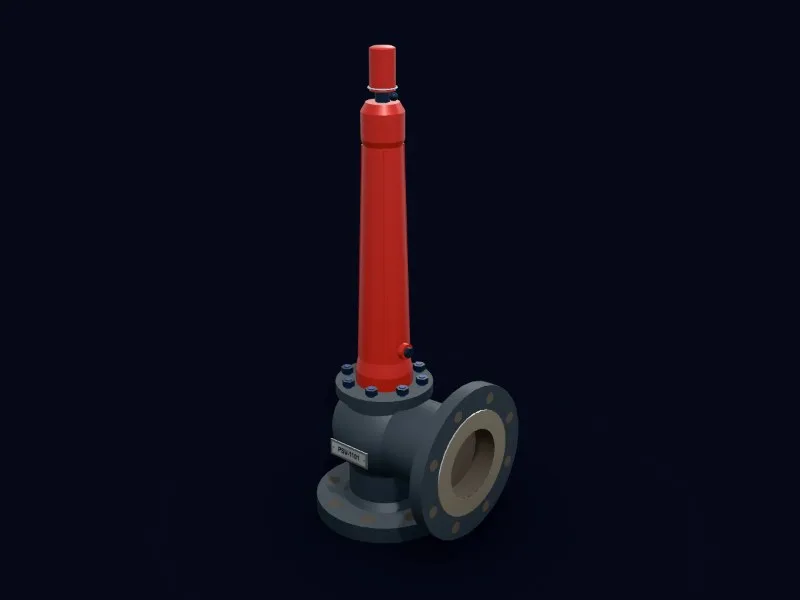 Pressure safety valve (PSV)
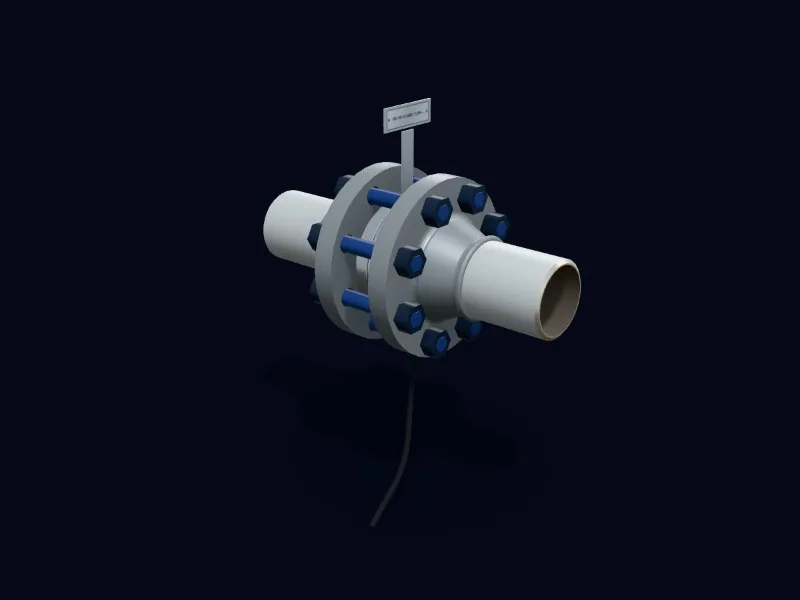 Rupture disc (rupture disk) assembly

Questions
What is the P&ID symbol for a pressure safety valve?
On most legends, an angle body with the inlet from below and the outlet to the side, and a spring on top. Here the spring is a zig-zag capped by a short bar. A PSV tag with the set pressure usually sits beside it. See the PSV symbol.
What is the difference between a PSV and a PCV on a P&ID?
A PSV stays shut until its set pressure and then lifts to protect the equipment. A PCV is a self-actuated regulator that throttles all the time to hold a pressure. The PSV is drawn as an angle body with a spring. The PCV is a straight body with a diaphragm dome and a sensing line.
What does 3L4 mean on a relief valve?
It is the valve size: a 3 inch inlet, an L orifice and a 4 inch outlet. The orifice letters and their areas are set out in API 526.
How is a rupture disc shown on a P&ID?
This library draws it as two short parallel bars across the pipe for the disc holder, with a curved arc between them that bulges towards the outlet. Some legends draw a dashed or zig-zag line across the pipe instead. Its ISA tag is PSE, for pressure safety element. See the rupture disc symbol.
Is a PRV the same as a PSV?
On many drawings PRV and PSV both mean a pressure relief valve. On some legends PRV means pressure regulating valve instead, so check the legend sheet before reading it as a relief device.
Other symbol categories
- Valves 23
- Check valves 6
- Actuators, operators and valve accessories 25
- Piping fittings and specials 37
- Lines and signals 16
- Connectors, boundaries and annotations 11
- Instrument bubbles and functions (ISA 5.1) 14
- Primary elements and field instruments 30
- Vessels, columns and tanks 13
- Heat transfer equipment 12
- Pumps 9
- Compressors, blowers and drivers 15
- Filters, separators and mixers 10
- Flare, wellhead, pipeline and packages 16
- Fire & gas and fire protection 24
- Electrical (single-line) 23