Vessel and tank P&ID symbols
Vessels are the largest shapes on a P&ID and are drawn close to their real outline: a rectangle with dished heads, standing up or lying down. What is drawn inside helps with the service: a mesh pad, a weir, trays or packing. Tanks are told apart by their roofs. The shapes follow ISO 10628-2 and PIP PIC001.
13 symbols. Company legends vary, so the legend sheet of the drawing you are reading comes first.
How to read these symbols
Vertical or horizontal
A tall rectangle with rounded heads is a vertical vessel, often a separator or scrubber. A long one lying down is a horizontal drum: a separator, surge drum, knock-out drum or drain drum. The nozzles give the flow: gas leaves from the top and liquid from the bottom.
Internals
A zig-zag or hatched band near the top is a mist eliminator. It is the main feature of a scrubber, but separators often have one too. A small boot under a horizontal vessel, or an upright weir plate inside it, marks a three-phase separator with separate oil and water outlets. Short lines alternating left and right are trays. A box crossed corner to corner is a packed bed.
Tank roofs
A flat-bottomed tank with a shallow pointed roof is a cone-roof tank, and one with a curved roof is a dome-roof tank. An open top with a deck floating inside is a floating-roof tank. Pressure storage is drawn as a sphere on legs or a bullet on saddles. Atmospheric storage tanks are commonly built to API 650.
Tags and data
Vessels are usually tagged V or D, columns T or C, and tanks T or TK. Design pressure, temperature and size are written beside the shape, not shown by it, and the vessel datasheet holds the rest.
All 13 symbols


Download the legend sheet (SVG)Whole legend (SVG)
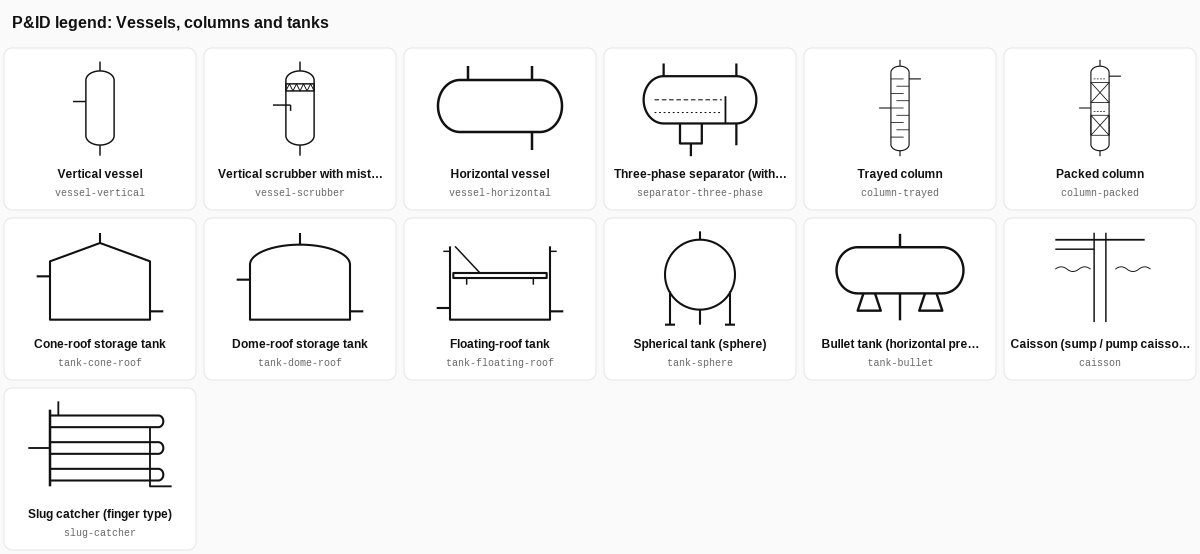

How each symbol is drawn
| Symbol | Drawn as | Tags |
|---|---|---|
| Vertical vessel | A tall rectangle with rounded (dished) top and bottom heads, with nozzles: inlet on the side, gas at the top, liquid at the bottom. Equipment tag and design data written beside it. | V, D |
| Vertical scrubber with mist eliminator | A vertical vessel with a band near the top filled with a zig-zag or cross-hatch (the mesh pad or vane pack) and an inlet on the side below it. | V |
| Horizontal vessel | A long horizontal rectangle with rounded heads at both ends, with nozzles on the top and bottom. | V, D |
| Three-phase separator (with boot and weir) | A horizontal vessel with a small vertical boot under it (a short rectangle), and an upright weir plate inside towards the outlet end. Separate oil and water outlets. | V |
| Trayed column | A tall vertical vessel with dished heads and short horizontal lines inside that alternate from left to right (the trays). | T, C |
| Packed column | A tall vertical vessel with one or more rectangles crossed corner to corner (an X), the packed beds, each with a short distributor line above it. | T, C |
| Cone-roof storage tank | A wide flat-bottomed rectangle with a shallow pointed (conical) roof. | T, TK |
| Dome-roof storage tank | A wide flat-bottomed rectangle with a curved (domed) roof. | T, TK |
| Floating-roof tank | A flat-bottomed tank with an open top and a horizontal deck floating inside below the rim, often with a rolling ladder drawn diagonally from the rim to the deck. | T, TK |
| Spherical tank (sphere) | A circle standing on vertical legs. | T, TK, V |
| Bullet tank (horizontal pressure storage) | A horizontal vessel with rounded heads standing on two saddles, sometimes inside a mound (a hump of earth). | T, TK, V |
| Caisson (sump / pump caisson) | A long vertical tube hanging down from the deck through the sea surface (a wavy line), open at the bottom. | CS, X |
| Slug catcher (finger type) | Several long parallel pipes (fingers) joined at the inlet end by a manifold, with gas risers at the inlet end and a liquid header at the far end. | V, SC |
3D components for these symbols
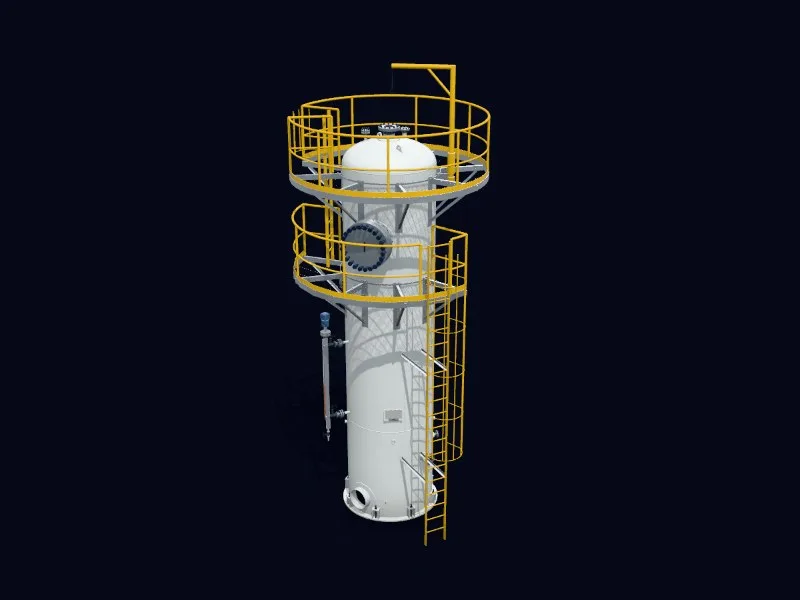 Vertical separator / scrubber
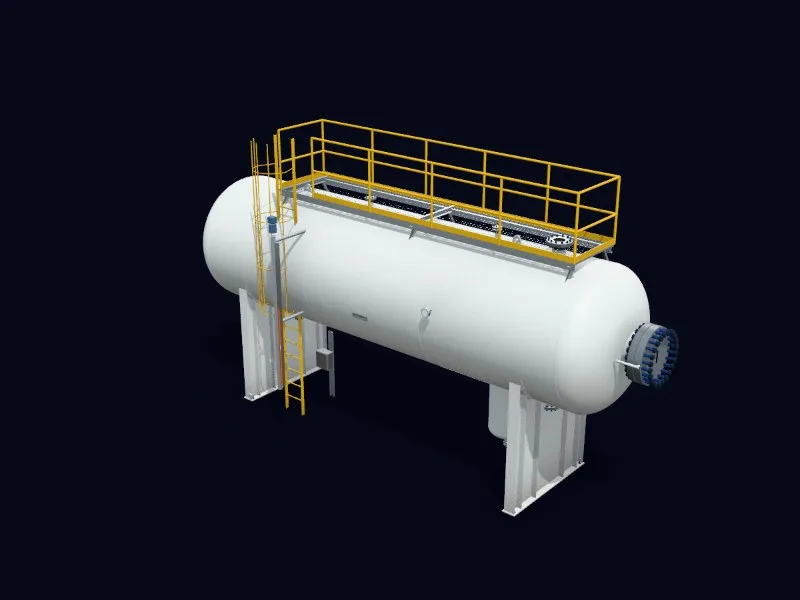 Horizontal separator
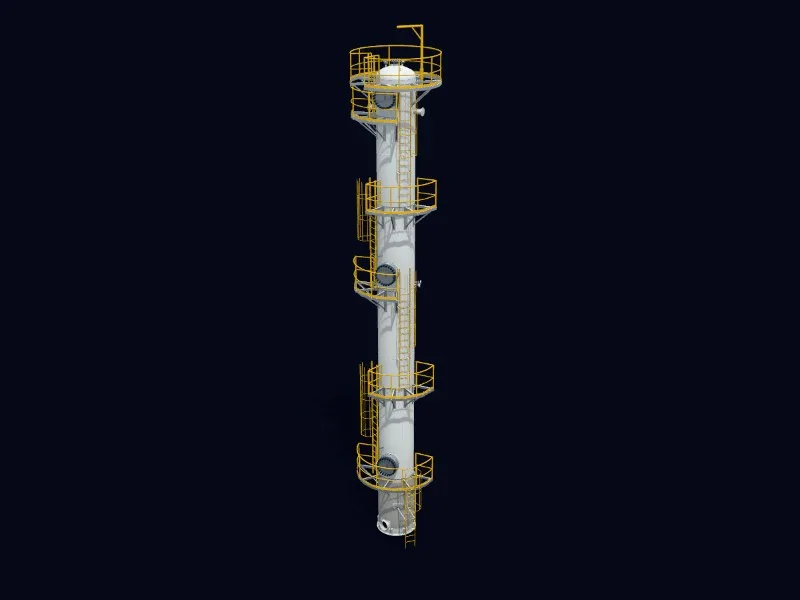 Trayed / packed column
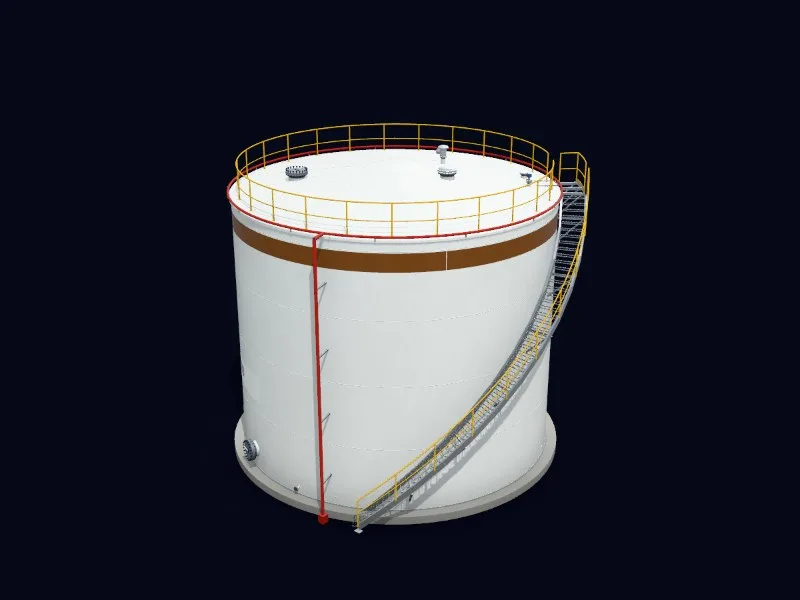 Atmospheric storage tank (API 650)
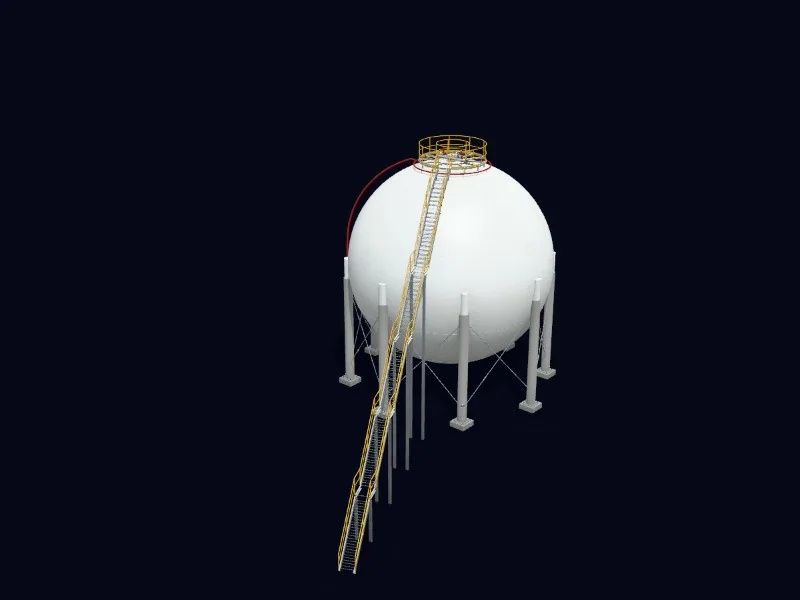 LPG sphere
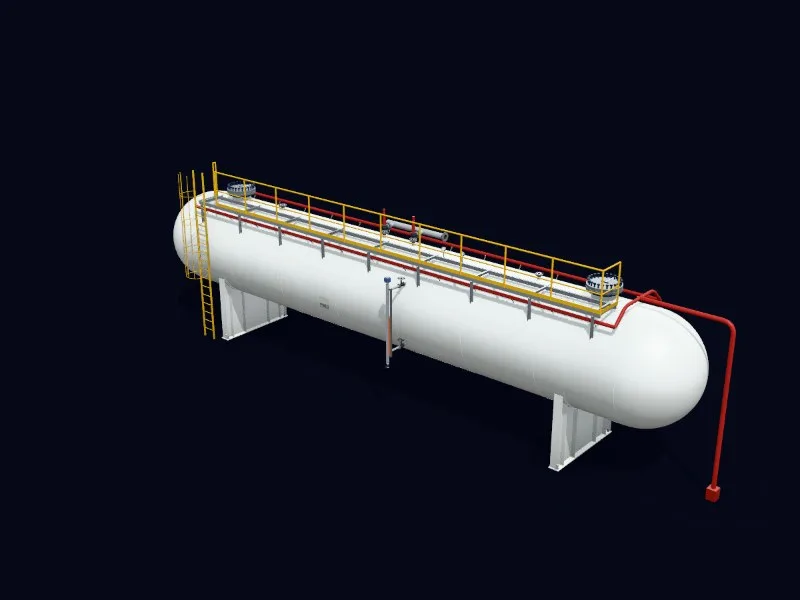 LPG / propane bullet tank
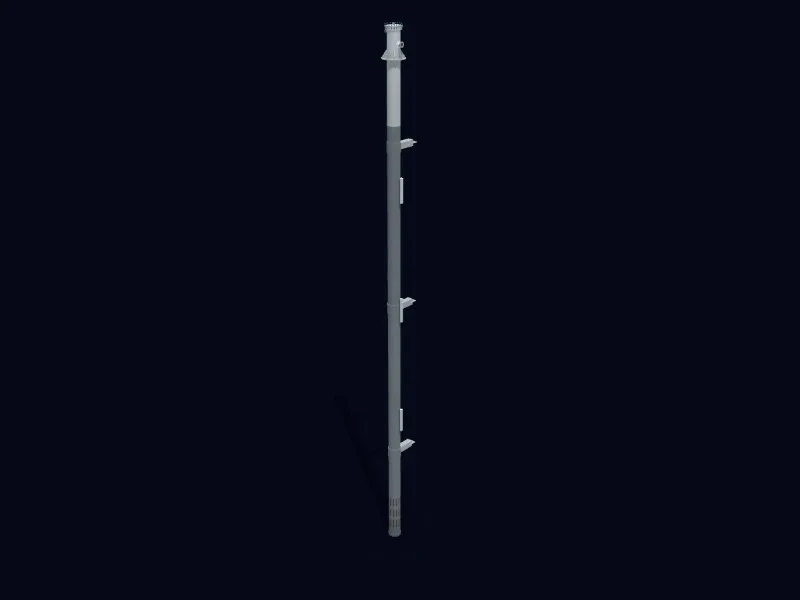 Deck-hung caisson
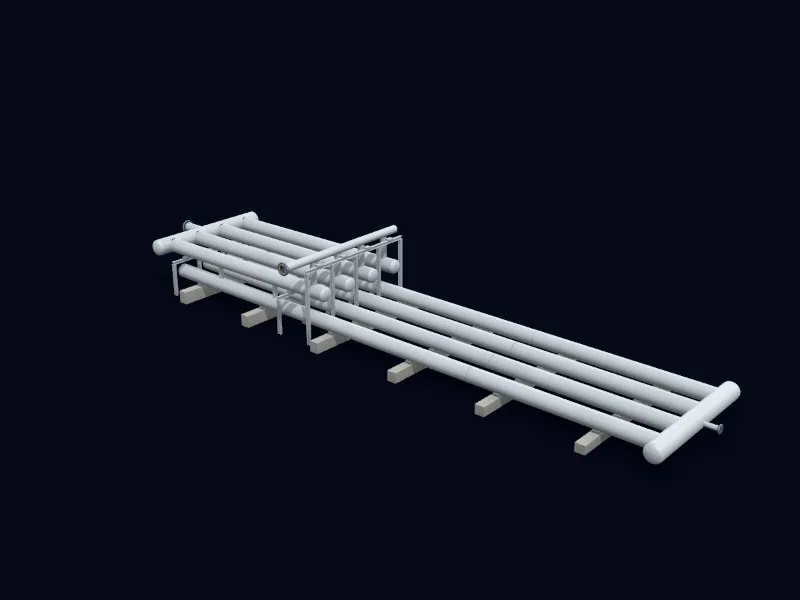 Finger-type slug catcher
Questions
What is the symbol for a three-phase separator?
A horizontal vessel with a small vertical boot under it and an upright weir plate inside towards the outlet end, with separate oil, water and gas outlets. Some have no boot and hold the interface with the weir alone. See the three-phase separator symbol.
How do you tell a scrubber from a separator on a P&ID?
A scrubber is a vertical vessel with a zig-zag or hatched band near the top, the mist eliminator, and an inlet below it. Separators often have a mist eliminator too, so the tag and the service in the title block are the surer guide. A plain vertical vessel has no band.
What is the difference between a trayed and a packed column symbol?
A trayed column has short horizontal lines inside that alternate from left to right. A packed column has one or more rectangles crossed corner to corner, each with a distributor line above it.
What does a floating-roof tank look like on a P&ID?
A flat-bottomed tank with an open top and a horizontal deck drawn inside below the rim, often with a ladder drawn from the rim down to the deck. See the floating-roof tank symbol.
Other symbol categories
- Valves 23
- Check valves 6
- Relief, regulators and safety devices 9
- Actuators, operators and valve accessories 25
- Piping fittings and specials 37
- Lines and signals 16
- Connectors, boundaries and annotations 11
- Instrument bubbles and functions (ISA 5.1) 14
- Primary elements and field instruments 30
- Heat transfer equipment 12
- Pumps 9
- Compressors, blowers and drivers 15
- Filters, separators and mixers 10
- Flare, wellhead, pipeline and packages 16
- Fire & gas and fire protection 24
- Electrical (single-line) 23