ISA 5.1 instrument symbols
Every instrument function on a P&ID is a small shape with tag letters inside. The outline says what does the work. A circle is a discrete instrument, and a circle in a square is a function of the basic process control system, usually the DCS. A diamond in a square is an alternate system or the SIS, and a hexagon is a computer function. The lines across the shape say where the operator can reach it. The shapes and letters come from ISA 5.1.
14 symbols. Company legends vary, so the legend sheet of the drawing you are reading comes first.
How to read these symbols
The line through the bubble
No line means the device is mounted in the field. One solid line means it is in the main control room, where the operator can reach it. Two lines mean a local or auxiliary panel. A dashed line means it is behind the panel or somewhere else the operator cannot reach. The same rule applies to the square, diamond and hexagon.
Square, diamond and hexagon
A circle inside a square is a shared display or control function. Since the 2009 edition of ISA 5.1 it stands for the basic process control system, whatever the hardware, which is usually the DCS. A diamond inside a square stands for an alternate control system or a safety instrumented system, and the legend says which. Older drawings use it for a PLC. A hexagon is a computer function, such as a totaliser.
Tag letters
The first letter is the measured variable: P pressure, T temperature, L level, F flow, A analysis. The letters after it are functions: I indicate, T transmit, C control, S switch, A alarm, V valve, E element. So PIT is a pressure indicating transmitter and LIC a level indicating controller, followed by the loop number. Some letters are left to the user, so company legends fill them differently. The identification letters page lists them all.
Alarms, voting and touching bubbles
Letters beside a bubble such as H, HH, L and LL mark alarm settings. HH and LL are often trip settings rather than alarms, and the cause and effect chart says which. Text such as 2oo3 where signals join gives the voting. Two bubbles drawn touching are one instrument with two functions, for example a PIT with a PSHH.
All 14 symbols


Download the legend sheet (SVG)Whole legend (SVG)
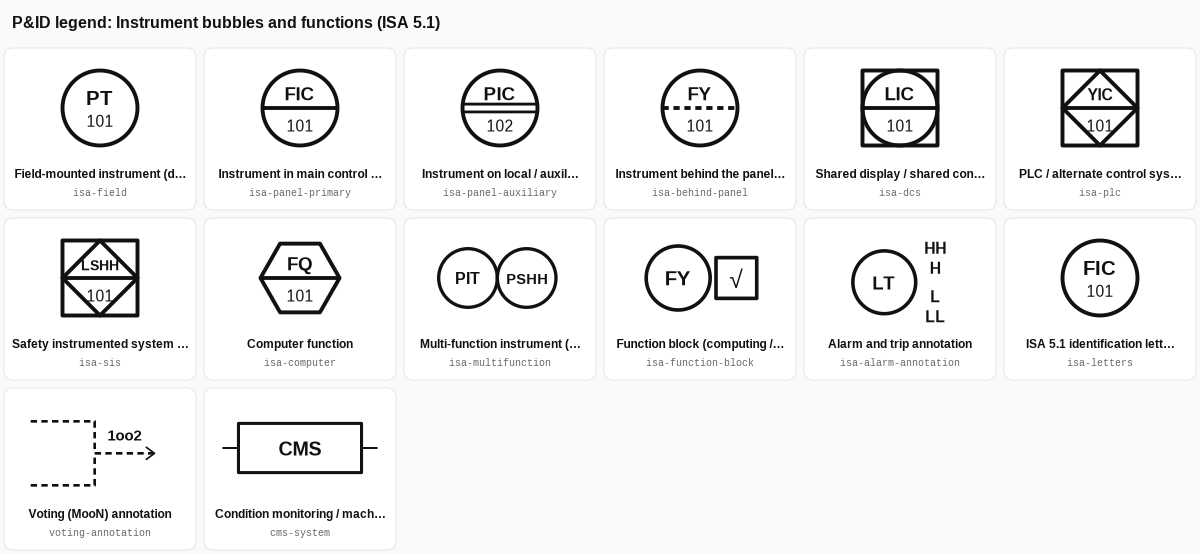

How each symbol is drawn
| Symbol | Drawn as | Tags |
|---|---|---|
| Field-mounted instrument (discrete) | A plain circle with no horizontal line, containing the tag letters and usually the loop number. | PI, PT, TT, LT, FT |
| Instrument in main control room (primary location) | A circle with one solid horizontal line across the middle; letters above the line, loop number below. | FIC, PIC, LIC, TIC, HS |
| Instrument on local / auxiliary panel | A circle with two parallel horizontal lines across the middle (a double bar). | PIC, HS, XA |
| Instrument behind the panel (not accessible) | A circle with a dashed horizontal line across the middle. | FY, PY, TY |
| Shared display / shared control (DCS) | A circle inside a square, with a solid horizontal line across, letters above and loop number below. | FIC, PIC, LIC, TIC, FI, PI, LI, TI |
| PLC / alternate control system function | A diamond inside a square, with a horizontal line across when operator-accessible. | YIC, XC, HS |
| Safety instrumented system (SIS) function | A diamond inside a square (with a bar when operator-accessible), carrying a trip function such as LSHH or PSHH. Many legends add "SIS" or a distinct colour or letter. | LSHH, PSHH, XS |
| Computer function | A hexagon (pointed left and right), with a horizontal line across when operator-accessible. | FQ, UY, KY |
| Multi-function instrument (touching bubbles) | Two bubbles drawn touching side by side, each with its own letters, e.g. PIT and PSHH. | PIT, PSH, TT, TSH |
| Function block (computing / signal conversion) | A small square drawn beside a bubble (usually a Y relay or compute bubble) containing a math or conversion symbol: √, Σ, ×, ÷, I/P, f(x), >, <. | FY, TY, PY |
| Alarm and trip annotation | Small letters next to a bubble: H, HH, L, LL (or AH, AHH, AL, ALL), sometimes with a setpoint value. | H, HH, L, LL |
| ISA 5.1 identification letters (instrument tag naming) | Tag letters inside any bubble, e.g. "FIC" over "101". The ISA tag naming convention is: first letter = measured variable, following letters = functions, then the loop number. | |
| Voting (MooN) annotation | Text such as 1oo2, 2oo2 or 2oo3 written beside the signal lines where two or more measurements join into one alarm, trip or SIS function. | |
| Condition monitoring / machinery protection system (CMS) | A rectangle labelled CMS (or MPS, VMS), or the letters CMS written beside vibration and bearing-temperature alarm functions. |
Questions
What does a line through an instrument bubble mean?
It says where the instrument is. No line: in the field. One solid line: in the main control room. Two lines: on a local or auxiliary panel. A dashed line: behind the panel, out of the operator's reach. See control room instrument and behind the panel.
What does a circle inside a square mean on a P&ID?
A shared display or shared control function in the basic process control system, usually the DCS: something the operator sees on a screen rather than a separate device. See the DCS symbol.
What does PIC mean on a P&ID?
Pressure indicating controller: P for pressure, I for indicate and C for control. The loop number comes after the letters, as in PIC-101.
How are SIS functions shown on a P&ID?
Often as a diamond inside a square carrying a trip function such as LSHH or PSHH. ISA 5.1 lets the user assign that shape to the SIS or to an alternate control system, so many legends add SIS, a colour or a project letter. See the SIS function symbol.
What does 2oo3 mean on a P&ID?
Two out of three: three measurements feed one trip, and the trip acts when any two of them agree. Other common votes are 1oo2 and 2oo2. See the voting annotation.
Other symbol categories
- Valves 23
- Check valves 6
- Relief, regulators and safety devices 9
- Actuators, operators and valve accessories 25
- Piping fittings and specials 37
- Lines and signals 16
- Connectors, boundaries and annotations 11
- Primary elements and field instruments 30
- Vessels, columns and tanks 13
- Heat transfer equipment 12
- Pumps 9
- Compressors, blowers and drivers 15
- Filters, separators and mixers 10
- Flare, wellhead, pipeline and packages 16
- Fire & gas and fire protection 24
- Electrical (single-line) 23