P&ID connector, boundary and annotation symbols
None of these carries fluid. They tell you where a line goes when it leaves the sheet, where the scope ends, and what has changed or is still on hold. Most come from PIP PIC001 and company drafting practice, so their exact shapes vary more than in most groups.
11 symbols. Company legends vary, so the legend sheet of the drawing you are reading comes first.
How to read these symbols
Following a line off the sheet
An off-page connector is a pentagon pointing in the flow direction. An outgoing one says TO with the drawing number and destination, and an incoming one says FROM. The line number should match on both sheets. A small circle with a single letter joins two ends of a line on the same sheet.
Scope boundaries
A dash-dot line across a pipe, labelled B.L., is a battery limit, often with the scope owner on each side. A dash-dot rectangle around equipment is a package or vendor boundary, with the package tag in a corner. A tie-in is a bar across the line where new pipe meets existing pipe, with a leader to its number, such as TP-01.
Notes, holds and revisions
A number in a small hexagon, flag or box points to the notes block. A scalloped cloud marks a hold or a change, often with a revision triangle beside it. Treat anything clouded as provisional until the hold is lifted.
Interlocks
On many legends a diamond with I inside is an interlock, with signal lines in and out. The P&ID only flags it. The logic itself is set out on a cause and effect chart or a logic diagram, and ISA 5.2 covers binary logic diagrams.
All 11 symbols


Download the legend sheet (SVG)Whole legend (SVG)
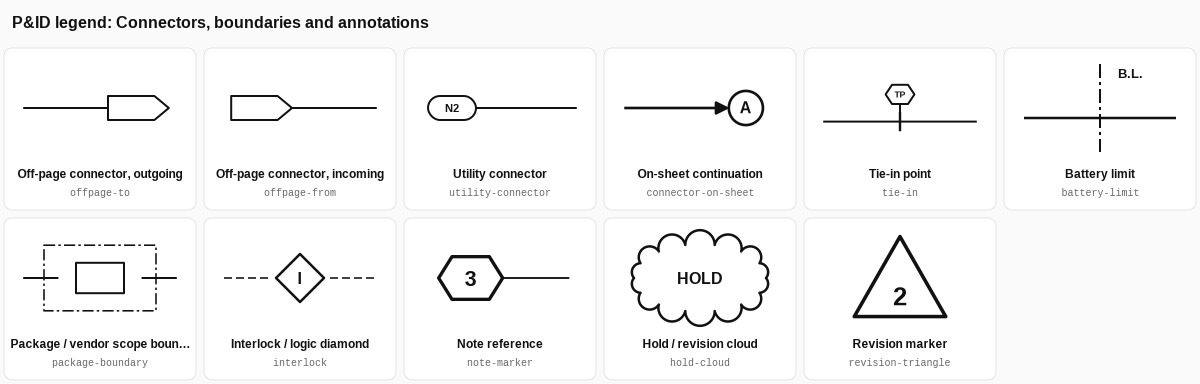

How each symbol is drawn
| Symbol | Drawn as | Tags |
|---|---|---|
| Off-page connector, outgoing | The line ends at the flat side of a pentagon (an arrow-shaped box) that points away in the flow direction. The destination drawing number and the service or equipment, e.g. "TO PID-102 / V-2100", are written inside or beside it (left blank here). | |
| Off-page connector, incoming | A pentagon at the start of the line, pointing into the line in the flow direction, with "FROM PID-…" and the source text inside or beside it (left blank here). | |
| Utility connector | A small rounded box at a line end with the utility code inside (e.g. N2, IA, UA, PW, FG). | |
| On-sheet continuation | A line ending in an arrow at a small circle with a letter; the same letter appears where the line resumes on the same sheet. | |
| Tie-in point | A bar across the line where new pipe joins existing pipe, with a leader to a hexagon or flag holding the tie-in number (e.g. TP-01). | TP, TI |
| Battery limit | A long dash-dot boundary line crossing the pipe, labelled "B.L." or "BATTERY LIMIT", often with the scope owner written on each side. | BL |
| Package / vendor scope boundary | A dash-dot rectangle drawn around a group of equipment and piping, with the package tag and vendor written in a corner, and connections crossing its edge. | |
| Interlock / logic diamond | A diamond with "I" (or an interlock number) inside, with signal lines in and out. | I |
| Note reference | A number inside a small hexagon (or a flag or box) with a leader to the item; the note itself is in the notes block. | |
| Hold / revision cloud | A scalloped (cloud) outline around part of the drawing, often with "HOLD" or a revision triangle. | |
| Revision marker | A small triangle with a revision number or letter inside, next to a change (often inside a cloud). |
Questions
What is an off-page connector on a P&ID?
A pentagon at the end of a line, pointing in the flow direction, that names the drawing the line continues on. Outgoing connectors say TO and incoming ones say FROM. See the outgoing and incoming connectors.
What is a battery limit on a P&ID?
The boundary of a unit or contract scope, usually drawn as a long dash-dot line across the pipe and labelled B.L. or BATTERY LIMIT. See the battery limit symbol.
What does a tie-in point mean?
The place where new work connects to existing plant, by a hot tap, a cold cut or a flange break. Here it is a bar across the line with a numbered hexagon or flag, though tie-in marks vary between companies. See the tie-in symbol.
What does a cloud on a P&ID mean?
A scalloped outline marks a hold or a revision. HOLD means the design there is not final. A small triangle with a number next to it gives the revision the change belongs to. See the hold cloud and revision marker.
What is a utility connector?
A small box at the end of a line with a utility code inside, such as N2, IA, UA, PW or FG. It shows the line comes from or goes to a utility header drawn elsewhere. Some legends use an ellipse, a flag or a hexagon. See the utility connector.
Other symbol categories
- Valves 23
- Check valves 6
- Relief, regulators and safety devices 9
- Actuators, operators and valve accessories 25
- Piping fittings and specials 37
- Lines and signals 16
- Instrument bubbles and functions (ISA 5.1) 14
- Primary elements and field instruments 30
- Vessels, columns and tanks 13
- Heat transfer equipment 12
- Pumps 9
- Compressors, blowers and drivers 15
- Filters, separators and mixers 10
- Flare, wellhead, pipeline and packages 16
- Fire & gas and fire protection 24
- Electrical (single-line) 23