API 650
Welded tanks for oil storage
API 650 tanks explained: the standard for welded steel aboveground storage tanks, their parts, design limits, roof types, and API 620, 653 and 12F.
Scope
API Std 650 specifies the materials, design, fabrication, erection and testing of vertical, cylindrical, above-ground, welded steel tanks for storing petroleum and other liquids at atmospheric pressure or slightly above. It covers open-top and closed-top tanks, with annexes for floating roofs and other special cases.
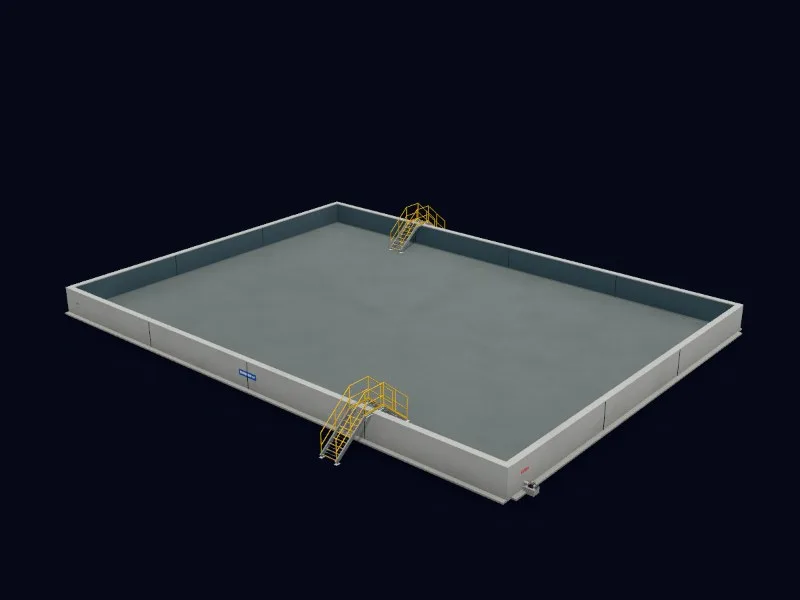
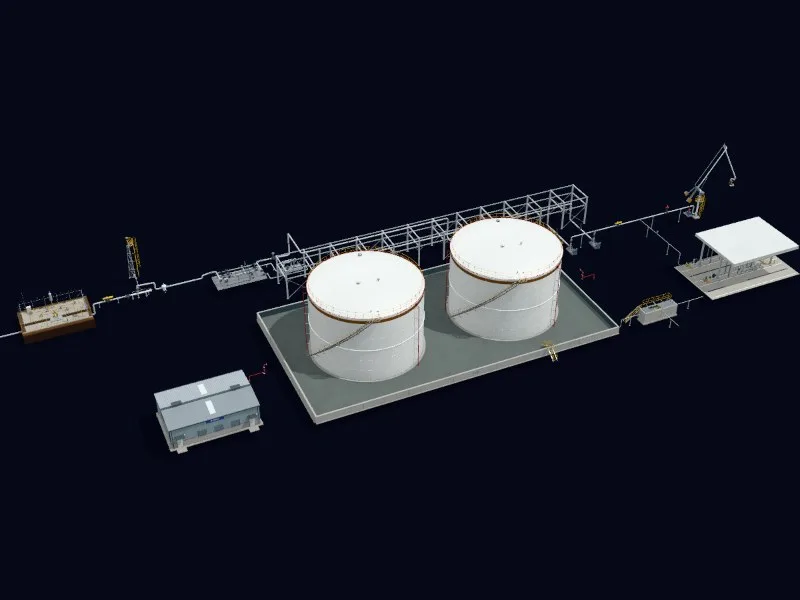
On onshore terminals, refineries and processing plants, API 650 tanks store crude, condensate, products, produced water, firewater and chemicals. They sit on ringwall foundations inside bunds, with venting to API 2000 and fire protection to NFPA 11 and NFPA 15.
Low-pressure tanks are covered by API 620, pressure storage of LPG by spheres and bullets under ASME VIII, and inspection and repair of tanks in service by API 653.
What API 650 is and who uses it
API 650, Welded Tanks for Oil Storage, is the recognised industry standard for welded steel aboveground storage tanks that hold petroleum products and other liquids. It is published by the American Petroleum Institute. The current edition is the fourteenth, issued in August 2025.
Owners and engineering contractors use it to specify a tank, tank contractors to design and build it, and inspectors to check it before it goes into service. Many choices are left to the purchaser, such as the roof type, the corrosion allowance and which annexes apply. They are recorded on the tank data sheet that comes with the standard.
An API 650 tank is normally built on site from steel plates. An annex of the standard covers smaller tanks assembled in a shop and shipped whole, and API 12F covers small shop-welded tanks for production service.
The parts of an API 650 tank
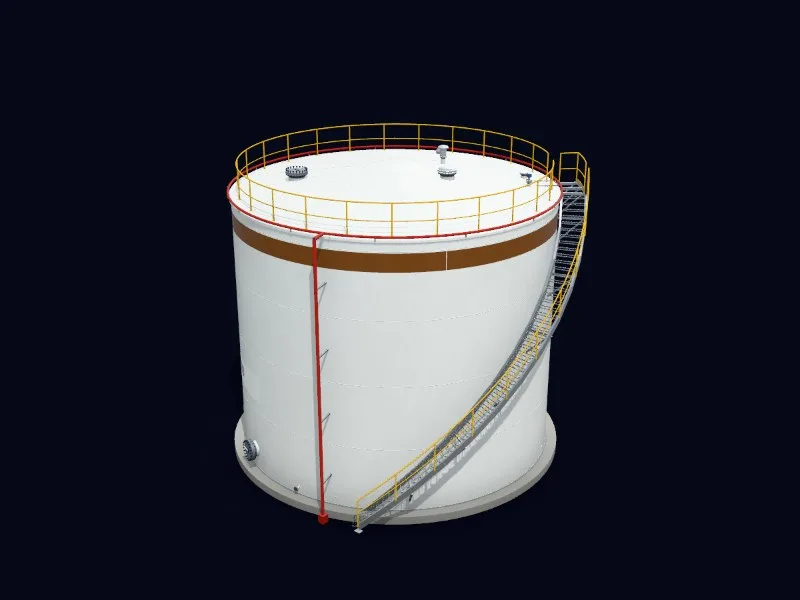
The shape is simple: a flat bottom, a vertical cylindrical shell and a roof. The shell is built from rings of plate called courses. Course 1, at the bottom, carries the most liquid pressure and is the thickest. The courses above it get thinner, because the pressure falls towards the surface.
The bottom rests on a prepared base, often with a concrete ringwall under the shell. Larger tanks have a ring of thicker annular plates under the shell, where the load and the bending at the corner joint are highest. Nozzles and manways in the lower courses are reinforced to replace the plate cut away for them. The library's atmospheric storage tank is built from the same parts.
API 650 design limits at a glance
The basic rules cover tanks at close to atmospheric pressure and moderate temperature. Annexes, which apply only when the purchaser asks for them, extend those limits.
| Item | Commonly quoted limit |
|---|---|
| Internal pressure, basic design | Close to atmospheric |
| Internal pressure, Annex F | Up to 18 kPa (2.5 psi) |
| Design vacuum | Annex V covers a vacuum above 0.25 kPa (1 in of water) |
| Maximum design temperature, basic design | 93 °C (200 °F) |
| Maximum design temperature, Annex M | Up to 260 °C (500 °F) |
| One-foot method for shell courses | Tanks up to about 61 m (200 ft) in diameter |
| Larger tanks | Variable-design-point method |
| Seismic design | Annex E |
| Current edition | Fourteenth edition, August 2025 |
These are commonly quoted reference values from recent editions, not a copy of the standard. Limits and annex letters can change between editions, so confirm them against the current edition.
Fixed and floating roofs
The roof is chosen mainly by how volatile the product is. A fixed cone or dome roof leaves a vapour space above the liquid. When the tank fills, or the sun warms it, that vapour is pushed out through the vents and lost.
A floating roof sits on the liquid and moves up and down with it, so there is almost no vapour space. An external floating roof is open to the weather. An internal floating roof is a light deck inside a fixed-roof tank. Crude oil and gasoline tanks often have floating roofs, while diesel, water and chemicals usually sit under a fixed roof.
How the shell thickness is worked out
- 1
Liquid height and product
Start from the design liquid level and the specific gravity of the product. The pressure at any point is the weight of the liquid above it.
- 2
Allowable stress
Each plate material has an allowable stress for the product case and a higher one for the hydrotest, when the tank holds water.
- 3
Corrosion allowance
The purchaser sets a corrosion allowance. It is added to the product case thickness, not to the hydrotest case.
- 4
Course thickness
The one-foot method or the variable-design-point method gives each course its thickness. The larger of the product and hydrotest results is used, and never less than the minimum for the tank diameter.
- 5
Wind and earthquake
Wind girders keep the upper shell round in strong wind. Where earthquakes are a risk, the tank is checked for overturning and for the sloshing of the liquid, and may need anchors.
- 6
Hydrotest
The finished tank is filled with water and checked for leaks and for settlement of the foundation before it goes into service.
API 650 and the neighbouring tank standards
Several standards sit close to API 650. The one to use depends on the pressure, on whether the tank is new, and on how it is built.
| Standard | Use it for |
|---|---|
| API 650 | New welded steel tanks at close to atmospheric pressure, normally built on site |
| API 620 | New low-pressure tanks, up to about 103 kPa (15 psi), including refrigerated storage |
| API 653 | Inspection, repair, alteration and reconstruction of tanks already in service |
| API 12F | Small shop-welded tanks for production liquids |
| API 2000 | Normal and emergency venting of the tank |
| ASME Section VIII and API 2510 | LPG and other liquids stored under pressure, in spheres and bullets |
API 650 tanks on oil and gas facilities
Onshore, API 650 tanks are used for crude and condensate at terminals, products at refineries, and produced water, firewater and chemicals on processing plants. Each tank or group of tanks sits inside a bund wall that holds a spill. Large crude tanks have foam systems and cooling water, and a fire monitor often covers the bund. Water spray systems follow NFPA 15.
Offshore platforms rarely have large API 650 tanks. Bulk crude storage offshore is in the hull of an FPSO or a storage vessel, and the tanks on a platform are small ones for diesel, water and chemicals. Liquids stored under pressure go in a spherical tank or a bullet tank, which are pressure vessels to ASME Section VIII Division 1.
Key concepts
- Shell courses
- The shell is built from horizontal rings of plate, called courses, that get thinner towards the top because hydrostatic pressure falls with height. Each course is checked for the product at design and for water at hydrotest.
- One-foot method
- For smaller tanks the thickness of each course is calculated at a point one foot above its bottom seam. Larger tanks use the variable-design-point method, which gives thinner, more economical courses.
- Roof types
- Fixed roofs are cone or dome shaped and either self-supporting or carried on rafters and columns. External and internal floating roofs ride on the liquid surface to cut vapour losses from volatile products.
- Wind girders
- Open-top tanks need a top wind girder, and tall shells need intermediate girders so that wind cannot buckle the upper courses.
- Bottom and annular plates
- The bottom is lap or butt welded plate on a prepared foundation. Larger or more highly stressed tanks have a ring of thicker annular plates under the shell.
- Emergency venting
- Normal and emergency venting follows API 2000. A frangible roof-to-shell joint lets the roof tear away before the shell or bottom fails if the tank is overpressured.
Questions
What is an API 650 tank?
It is a vertical, cylindrical, aboveground storage tank of welded steel, built to API Standard 650. It has a flat bottom on a prepared foundation and an open top, a fixed roof or a floating roof. It stores liquid at close to atmospheric pressure: the standard allows an internal pressure of up to about 18 kPa (2.5 psi) when its extra rules are applied. The atmospheric storage tank is a 3D model of one.
Which standard covers the design and construction of welded steel aboveground storage tanks?
API Standard 650 is the recognised standard for field-erected welded steel tanks that store petroleum, petroleum products and other liquids. Small shop-built tanks for production service follow API 12F. Many national codes and owner specifications refer to API 650.
What is the difference between API 650, API 620 and API 653?
API 650 covers new tanks at atmospheric pressure. API 620 covers new low-pressure tanks, up to about 103 kPa (15 psi), including refrigerated storage. API 653 covers tanks already in service: inspection, repair, alteration and reconstruction.
What are API 650 tanks used for?
They store crude oil, condensate, refined products, produced water, firewater and chemicals at close to atmospheric pressure. They are found at terminals, refineries, tank farms and onshore processing plants. Liquids stored under pressure, such as LPG, go in pressure vessels instead.
What is the maximum design pressure and temperature of an API 650 tank?
The basic design is for close to atmospheric pressure and a design temperature up to 93 °C (200 °F). Annex F allows an internal pressure up to 18 kPa (2.5 psi), and Annex M allows design temperatures up to 260 °C (500 °F). Tanks for higher pressures are designed to API 620.
What is the current edition of API 650?
The fourteenth edition, published in August 2025. API issues addenda and errata between editions, so check the API catalogue for the latest status before you cite one.
What is the difference between API 650 and API 12F?
API 650 covers tanks of any size up to very large diameters, normally built on site from plates. API 12F covers small tanks welded in a shop and shipped in one piece, for production liquids such as crude oil and produced water near the wells.
In Deck Twin
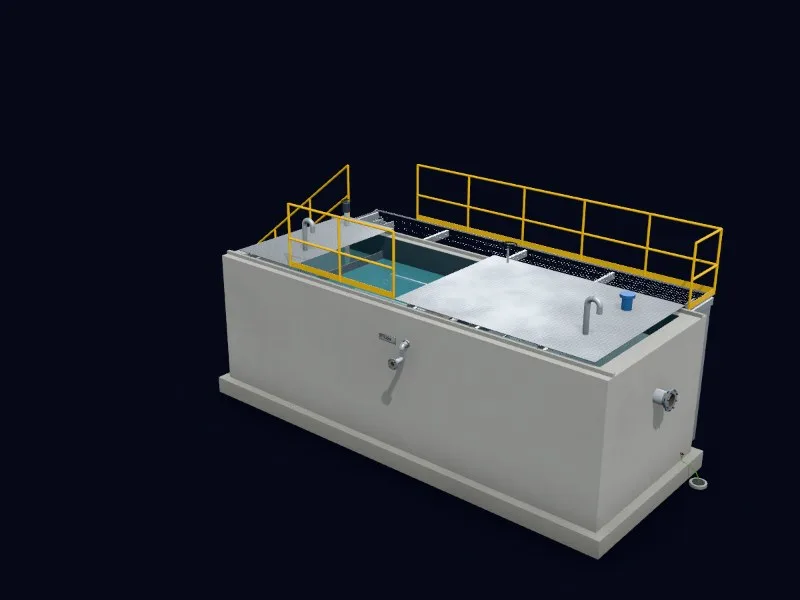
The atmospheric storage tank sizes its shell courses by the one-foot method from diameter, height and product gravity, adds an intermediate wind girder where the shell needs one, and offers a cone or dome roof. fireProtection adds foam chambers and a cooling spray ring. The oily-water separator has a steel variant built in the same way, and a tank bund wall can surround the tank. Plate thicknesses are reference values for visualisation, not a tank design.
Deck Twin uses these standards as reference values for visualisation. Check the current edition of each standard before using any value for design, procurement or fabrication.