DNV 2.7-1 / EN 12079
Offshore containers
DNV 2.7-1, now DNV-ST-E271, in plain words: the latest edition, container types, lift tests, sling sets, plates, inspections, EN 12079 and ISO 10855.
Scope
DNV 2.7-1, now published as DNV-ST-E271, is the DNV standard for the design, manufacture, testing and certification of offshore containers. EN 12079 is the European standard on the same subject, replaced in 2018 by EN ISO 10855, which keeps the same three parts. Part 1 covers design, manufacture and marking, part 2 covers lifting sets and part 3 covers periodic inspection.
An offshore container is a portable unit for repeated use in carrying goods to, from and between offshore installations and supply vessels. The category includes freight containers, cargo baskets, tanks for chemicals, gas cylinder racks and skids that are lifted on and off the platform.
Units that are installed permanently or serve as equipment offshore, rather than as cargo, are covered by DNV 2.7-3 for portable offshore units. Neither standard covers crane operations themselves.
What counts as an offshore container
An offshore container is a portable unit with an outer frame and padeyes, a maximum gross mass of up to 25,000 kg, built to be lifted again and again between supply vessels and offshore installations in open seas. DNV 2.7-1 sets how such a unit is designed, built, tested, certified, marked and inspected, and how its sling set is made.
The rules are stricter than for a shipping container on land. A crane lifting from a supply vessel that is rising and falling in a swell can snatch the load, and the container can land hard on a moving deck. The frame, padeyes and slings are designed for those loads.
A unit that is lifted once and then installed for good is not an offshore container. Neither is a unit without an outer frame and padeyes.
| Kind | What it is | Examples |
|---|---|---|
| Freight container | Built to carry goods | Closed cargo container, cargo basket, tank for fluids, bulk container, gas cylinder rack |
| Service container | Built and fitted out for a task, usually as a temporary installation | Workshop, laboratory, store, power unit, control station, wireline unit |
| Waste skip | Open or closed container for storing and removing waste | Skip with a loose or hinged lid |
Categories as long published in DNV 2.7-1. Check the current DNV-ST-E271 for the exact definitions.
Names and the latest edition
The standard has changed its name twice, which is why people search for it in several ways. It was DNV Standard for Certification No. 2.7-1, then DNVGL-ST-E271, and is now DNV-ST-E271. The title still reads 2.7-1 Offshore containers, so all three names point to the same document.
The current edition listed by DNV is Edition 2023-03, amended 2024-12. To check it yourself, search for DNV-ST-E271 on dnv.com: the standard's page shows the edition and how to get access. Many containers in service were certified to older editions. Their certificate names the edition they were built to.
| Name | Used for |
|---|---|
| DNV 2.7-1 (Standard for Certification No. 2.7-1) | The original DNV name, still the most common in conversation and on older certificates |
| DNVGL-ST-E271 | The name used after the DNV GL merger |
| DNV-ST-E271 | The current name: 2.7-1 Offshore containers, Edition 2023-03, amended 2024-12 |
The parts of an offshore container
The frame is the main structure. It protects the cargo and carries the load from the floor to the padeyes. Padeyes are welded to the frame, normally one at each top corner. A shackle joins each padeye to a leg of the sling set.
The sling set usually has four legs that meet at a master link, sometimes with a single forerunner up to the crane hook. The legs are normally designed at 45° from vertical and must not be wider than that. The sling set is certified with the container, tagged, and stays with it. Fork pockets in the base let a forklift move the unit on deck.
Each unit carries two plates. The data plate gives the maker, date and serial number, the maximum gross mass at the design sling angle, the tare mass, the payload and the certificate number. The inspection plate is stamped at every periodic inspection.
How a container is proven
A new design is reviewed and then tested on a prototype before production starts. The numbers below have long been published in DNV 2.7-1 and are the ones engineers quote most. Check them against the current DNV-ST-E271 before you use them.
- 1
Design review
The design is checked for the dynamic loads of offshore lifting, at the design sling angle. Padeyes are sized for the sling load, not just the static weight.
- 2
All-point lifting test
The prototype is loaded to a total of 2.5 times its maximum gross mass R and lifted on all its padeyes. It must show no significant permanent deformation.
- 3
Diagonal lifting test
A four-padeye container is also lifted from two diagonally opposite padeyes at 1.5 times R.
- 4
Vertical impact test
With its payload inside, the container is dropped or lowered onto a hard floor at an angle, so one bottom corner takes the impact. This copies a hard landing on a moving deck.
- 5
Production
Welds are inspected, and some units from a production batch are lift tested. The number is agreed with the certifier in advance.
- 6
Certification
The certifier issues the certificate, and the data plate is fixed to the unit. The sling set has its own certificate and tag.
Periodic inspection
To keep its certificate valid, a container is inspected at least once a year. Every fourth year the inspection adds non-destructive examination (NDE) of the padeyes. After a substantial repair or change, the unit is proof load tested again. Each inspection is stamped on the inspection plate with a letter: V for visual, VN for visual and NDE, T for test.
Tank containers that carry dangerous goods are also inspected under the IMDG Code. National authorities may ask for more frequent inspections.
DNV 2.7-1, EN 12079, ISO 10855 and DNV 2.7-3
EN 12079 was the European standard for offshore containers, in three parts: design, lifting sets and periodic inspection. In 2018 it was replaced by EN ISO 10855, which has the same three-part layout. Part 1 of ISO 10855 had a second edition in November 2024, and part 3 was also revised in 2024. IMO MSC/Circ.860, the international guideline for approving offshore containers, still names EN 12079, so both names appear on certificates and in contracts.
DNV 2.7-1 and these standards cover the same ground and are closely aligned. Units certified to DNV 2.7-1 have long been stated to also meet EN 12079 parts 1 and 2. If you are asked for an offshore module rather than a container, look at the neighbouring DNV standards. A 2.7-1 container that is fitted out to work on an installation, such as a workshop or control station, also has to meet the installation's own rules, and DNV 2.7-2 adds those requirements on top. DNV 2.7-3 covers portable units that are not containers at all: skids and packages that do a job offshore rather than carry cargo.
| Document | Covers | Status |
|---|---|---|
| DNV-ST-E271 (2.7-1) | Offshore containers up to 25,000 kg and their sling sets: design, testing, certification, marking, periodic inspection | Current: Edition 2023-03, amended 2024-12 |
| EN 12079 parts 1 to 3 | The same subject, as a European standard | Replaced by EN ISO 10855 in 2018; still named in IMO MSC/Circ.860 |
| ISO 10855 parts 1 to 3 | Containers, lifting sets, and periodic inspection, examination and testing | Part 1: second edition, November 2024. Part 3: 2024 edition. Check part 2 for its current edition |
| DNV-ST-E272 (2.7-2) | Containers and equipment fitted out to work on an installation; once called offshore service modules, now titled equipment assemblies | Check DNV for the current edition |
| DNV-ST-E273 (2.7-3) | Portable offshore units: skids and packages that do a job offshore | Check DNV for the current edition |
Editions as listed by DNV and ISO in November 2026. Check the publisher before citing one.
Tote tanks and cylinder quads
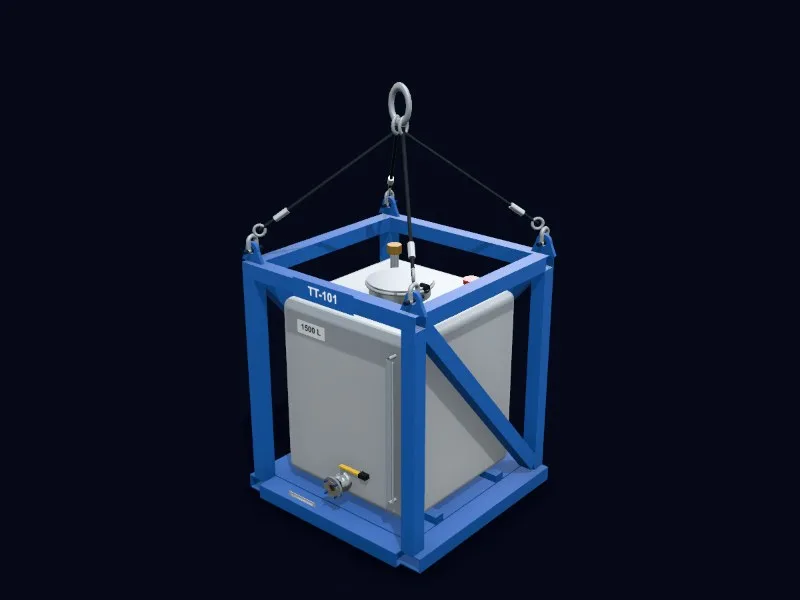
An offshore tote tank is a tank inside a steel lifting frame. The frame is certified as an offshore container, and the valves and fittings sit inside it, clear of the base, so a hard landing does not knock them off. A tank that carries dangerous goods also needs approval under the IMDG Code. A plain IBC is not built for offshore lifts and is not an offshore container.
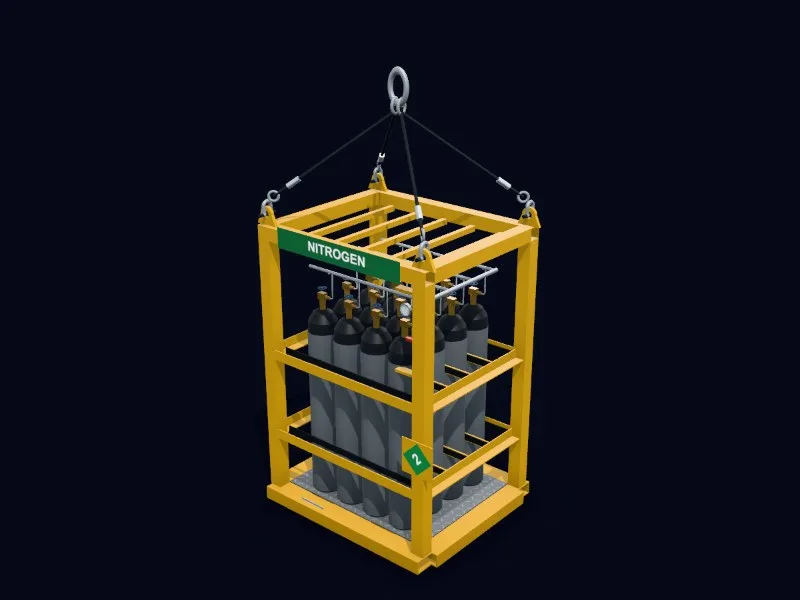
A cylinder quad, or gas cylinder bundle, is a set of high-pressure gas cylinders clamped in a lifting frame and piped to one outlet valve. Offshore, the frame is lifted and certified as an offshore container (a gas cylinder rack). The cylinders and their manifold follow the gas cylinder rules, and ISO 10961 covers cylinder bundles. The same thinking applies to a cargo basket and to a closed shipping container fitted with an offshore lifting set.
A short checklist before a lift
- 1
Certificate
Is there a valid certificate for the unit and a separate one for its sling set?
- 2
Data plate
Is the data plate readable, and is the loaded mass within the maximum gross mass?
- 3
Inspection plate
Is the last stamp less than 12 months old?
- 4
Sling set
Does the sling set tag match the unit, and are the shackle pins secured?
- 5
Padeyes and frame
Are the padeyes free of cracks and the frame free of damage?
- 6
Loose items
Are doors and lids closed, and is the roof and frame clear of anything that could fall?
Key concepts
- Dynamic lifting loads
- Offshore lifts from a moving vessel cause snatch loads far above a static lift. The structure and padeyes are designed for high dynamic factors and proven by lift tests.
- Maximum gross mass
- Each unit is rated for a maximum gross mass, which is the unit plus its payload. This rating sets the design loads and is marked on the unit.
- Lifting sets
- Units are lifted with a certified sling set, usually four legs to a master link, with shackles at the padeyes. The sling set is certified with the container and stays with it.
- Padeyes and frame
- Padeyes are welded to the main frame and sized for the sling angle and dynamic load. The frame protects the contents and carries the load to the lifting points.
- Testing
- Prototype tests include lifting and drop or impact tests. Production units are then lift tested on a sample of each batch before they are certified.
- Marking and inspection
- Each unit carries a data plate with its gross mass, tare, payload and certificate. An inspection plate records the periodic inspections, which are usually made at least once a year.
Questions
What is DNV 2.7-1?
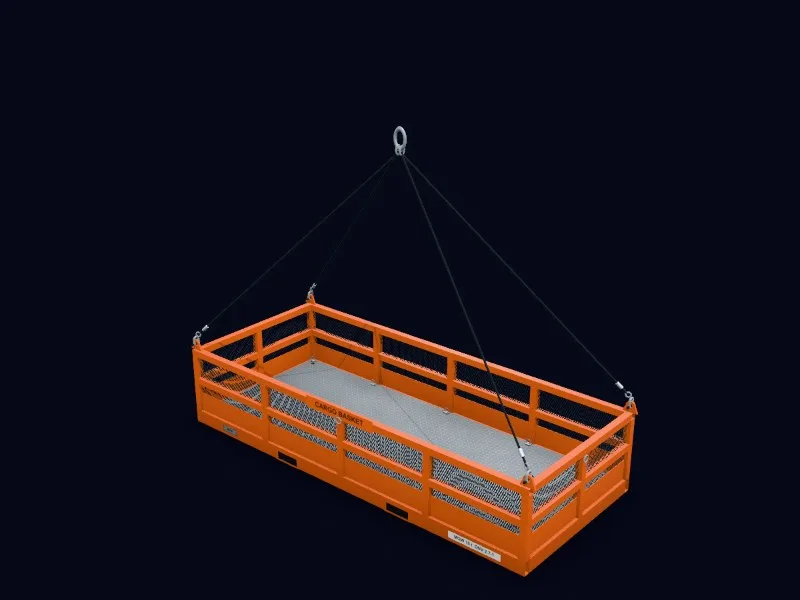
It is the DNV standard for offshore containers: portable units that are lifted again and again between supply vessels and offshore installations. It covers their design, manufacture, testing, marking and certification, including the lifting set. The cargo basket and tote tank are drawn as offshore containers.
What is the latest edition of DNV 2.7-1?
The standard is now called DNV-ST-E271, and its title still includes "2.7-1 Offshore containers". The current edition is dated March 2023 and was amended in December 2024. Earlier versions were DNV Standard for Certification 2.7-1 and DNVGL-ST-E271. DNV publishes it through its rules and standards service.
What is the difference between DNV 2.7-1 and EN 12079?
They cover the same subject and are closely aligned. DNV 2.7-1 is a certification standard: DNV reviews the design, surveys the production and issues the certificate. EN 12079, now EN ISO 10855, is a European and international standard that other certifying bodies can also certify to. Many containers are certified to both.
What is the difference between DNV 2.7-1 and DNV 2.7-3?
DNV 2.7-1 is for offshore containers that carry cargo, with a maximum gross mass of up to 25,000 kg. DNV 2.7-3, now DNV-ST-E273, is for portable offshore units: skids and packages that do a job offshore and do not fit the container definition. It allows heavier units and sets the lifting risk by operational class.
Is EN 12079 still current?
No. EN 12079 was replaced by EN ISO 10855 in 2018, which uses the same three parts. EN 12079 is still named in IMO MSC/Circ.860, and many units in service were certified to it, so it still appears on certificates. DNV 2.7-1, now DNV-ST-E271, remains current.
How often must an offshore container be inspected?
At least once every 12 months, with a thorough visual examination. Every 48 months the inspection also includes NDE of the padeyes. After a substantial repair the unit is proof load tested again. Each inspection is stamped on the inspection plate.
Is a gas cylinder quad an offshore container?
The frame is. Offshore, a cylinder bundle is lifted like any other cargo, so its frame and sling set are certified as an offshore container, for example to DNV 2.7-1. The cylinders and manifold follow the gas cylinder rules, and ISO 10961 covers bundles. See the gas cylinder quad.
What is the difference between an offshore container and an offshore module?
An offshore container carries goods or does a temporary job and is lifted again and again, under DNV 2.7-1. A container fitted out to work on an installation also meets DNV 2.7-2, which adds the installation's own requirements. Skids and packages that are not containers at all fall under DNV 2.7-3. On the Norwegian shelf, temporary equipment placed on an installation is also checked against NORSOK Z-015.
In Deck Twin
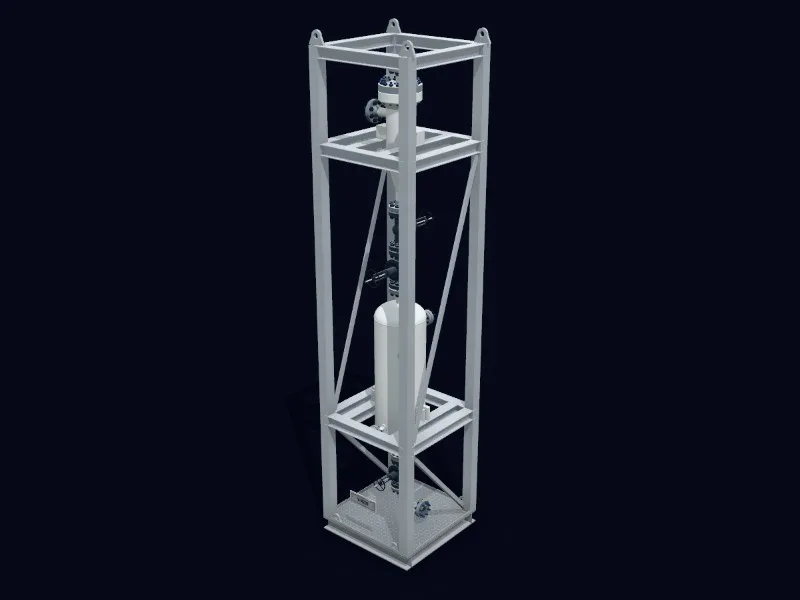
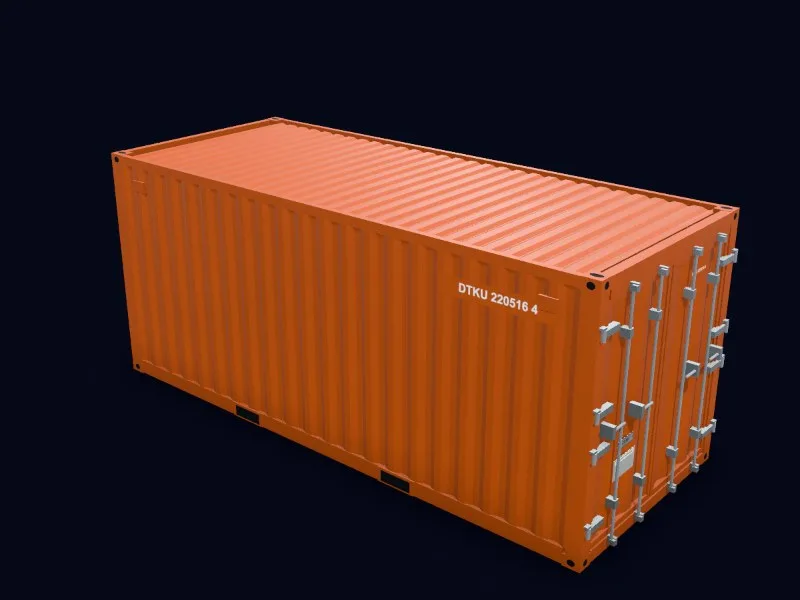
The cargo basket, tote tank and gas cylinder quad are drawn as offshore containers, with lifting frames, fork pockets, padeyes and four-leg sling sets. The shipping container adds an offshore lifting set with liftingSet, and the skid of the desander cites the same rules. There is no lib/standards function for it, and the frames and padeyes are not designed or certified.
Deck Twin uses these standards as reference values for visualisation. Check the current edition of each standard before using any value for design, procurement or fabrication.