NFPA 20
Installation of stationary fire pumps
NFPA 20 covers stationary fire pumps, their diesel or electric drivers and controllers. How firewater pumps are arranged offshore and onshore.
Scope
NFPA 20 covers the selection and installation of stationary pumps that supply fire protection systems. It includes the pump, the driver, the controller, the suction and discharge arrangement, and acceptance testing.
On oil and gas facilities it is the usual basis for firewater pumps. Offshore, diesel-driven pumps lift seawater from a caisson to the firewater ring main, which feeds deluge, monitors and hydrants. Onshore, pumps usually draw from a firewater tank or pond.
It does not size the firewater demand. That comes from the fire protection design, such as NFPA 15 deluge zones. The pump and driver performance limits must be checked against the current edition.
Key concepts
- Pump types
- NFPA 20 recognises horizontal split-case and end-suction pumps, and vertical turbine pumps for wells, caissons and open water. Offshore caisson pumps are normally vertical turbine pumps.
- Performance curve
- A listed fire pump must deliver at least 65 % of its rated head at 150 % of rated flow, and its shut-off head is limited. This keeps the pump useful when demand exceeds the design flow.
- Diesel drivers
- Diesel engines have duplicate starting batteries, a dedicated fuel tank and an engine cooling system. A heat-exchanger cooling loop fed from the pump discharge has a duplicated supply with strainers and a regulator.
- Controllers
- Each pump has a listed controller that starts it automatically on low header pressure and allows manual start. A fire pump does not stop on its own faults where that would leave the site unprotected.
- Redundancy
- Facilities normally install more than one fire pump, often with independent drivers and in separate locations, so that a single fire or failure cannot take out the whole supply.
- Acceptance testing
- Pumps are flow tested at commissioning across the curve, and then run and tested on a regular schedule.
Questions
What is NFPA 20?
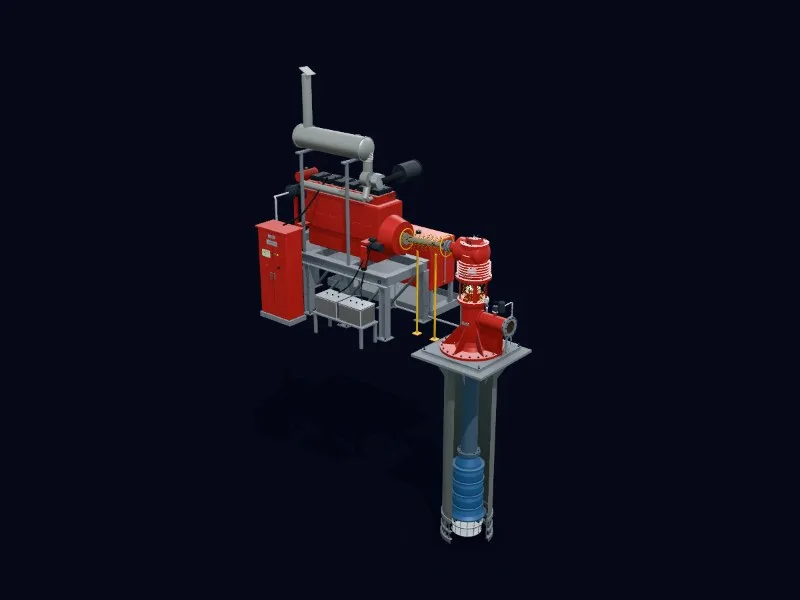
It is the NFPA standard for the installation of stationary fire pumps. It covers the choice of pump, the electric motor or diesel engine that drives it, the controller, the piping around the pump and the acceptance test. The diesel firewater pump is a 3D model of a diesel set.
What is the difference between NFPA 20 and NFPA 25?
NFPA 20 covers how a fire pump is selected and installed. NFPA 25 covers what happens afterwards: the inspection, testing and maintenance of fire pumps and other water-based fire protection systems.
Does NFPA 20 apply offshore?
Not automatically. It is an installation standard written mainly for buildings and land sites. Offshore projects adopt it through the project specification, usually with changes for caisson pumps, hazardous areas and the rules of the classification society or regulator.
In Deck Twin
The diesel firewater pump models a diesel fire pump set with day tank, silencer, starter batteries, controller and the duplicated engine cooling loop. pumpType chooses a vertical turbine caisson pump driven through a right-angle gear or a horizontal split-case pump. There is no lib/standards function for it, and the pump is not sized for a real firewater demand.
Deck Twin uses these standards as reference values for visualisation. Check the current edition of each standard before using any value for design, procurement or fabrication.