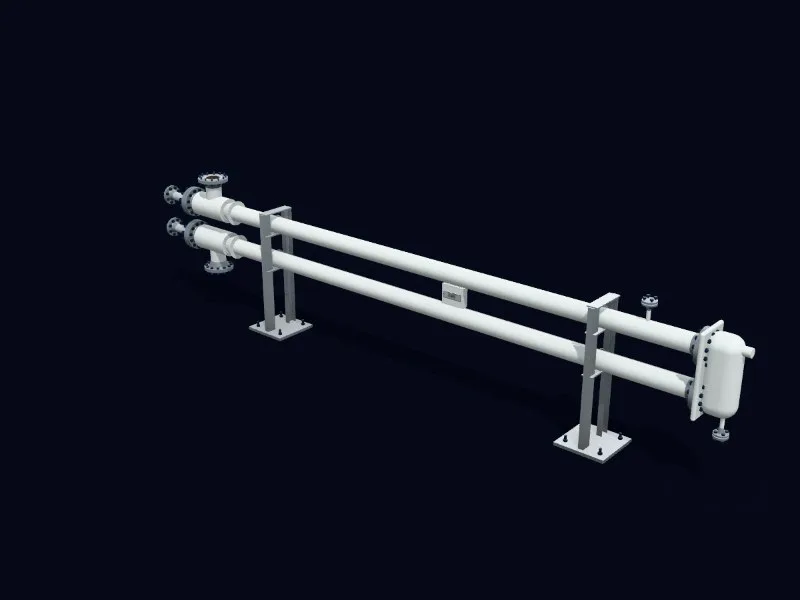
TEMA
Standards of the Tubular Exchanger Manufacturers Association
TEMA shell-and-tube heat exchanger standards in plain words: how to read a type such as AES or BEM, Classes R, C and B, and TEMA vs API 660.
Scope
The TEMA Standards cover the mechanical design, fabrication and tolerances of shell-and-tube heat exchangers. They define exchanger type designations, construction classes, tube and baffle details, tubesheet design, nozzle loads, and guidance on fouling and flow-induced vibration.
On oil and gas facilities shell-and-tube exchangers serve as crude coolers, gas coolers, glycol and amine exchangers, reboilers and condensers. Petroleum projects usually call up TEMA Class R together with API 660 and design the pressure parts to ASME Section VIII.
TEMA does not cover air-cooled exchangers (API 661), plate exchangers (API 662) or the pressure design rules themselves, which come from the pressure vessel code.
What TEMA is and who uses it
TEMA is the Tubular Exchanger Manufacturers Association, a group of shell-and-tube heat exchanger manufacturers founded in the United States in 1939. Its TEMA Standards are the construction standard that purchasers name for shell-and-tube exchangers in oil and gas, refining, chemicals and power.
The standards give everyone on a project the same language. A process engineer, a thermal designer, a fabricator and an inspector can read the type and class on a datasheet and know what will be built. The current issue is the 2026 Edition, sold as a subscription through TEMA's distributors.
TEMA does not replace the pressure vessel code. The shell, channels and tubesheets are pressure parts, so they are also designed to a code such as ASME Section VIII Division 1. TEMA adds the rules that are particular to exchangers on top of it.
How to read a TEMA designation
A full TEMA designation has a size and a type, for example Size 23-192 Type AES. The size gives the shell diameter and the tube length in inches. The type is three letters, read from the channel end to the far end of the exchanger.
- 1
Shell diameter
The first number is the nominal shell inside diameter in inches, rounded to the nearest inch. 23 means a shell of about 584 mm.
- 2
Tube length
The second number is the nominal tube length in inches. 192 means tubes 16 ft (4.9 m) long. For U-tubes it is usually the straight length up to the bend.
- 3
Front head
The first letter. A is a channel with a removable cover and B is a bonnet. The common letters are in the table after the key concepts.
- 4
Shell
The second letter. E, a one-pass shell, is by far the most common. F is a two-pass shell and K is a kettle reboiler.
- 5
Rear head
The third letter, and the one that decides maintenance. L, M and N are fixed tubesheets, U is a U-tube bundle, and S and T are floating heads.
- 6
Class
The datasheet also gives the TEMA class: R for petroleum and related processing, C for general commercial duty and B for chemical service. Oil and gas purchasers normally ask for Class R.
Choosing the rear head
The rear head decides two things. The first is whether the tube bundle can come out for cleaning. The second is how the exchanger copes when the tubes and the shell run at different temperatures and grow by different amounts. Three arrangements cover most exchangers.
| Type | Construction | Typical use |
|---|---|---|
| AES | Removable channel, one-pass shell, floating head with backing device | Fouling or hot service on both sides, such as crude coolers |
| AET | As AES, with a pull-through floating head | Where the bundle must come out often. Fewer tubes fit in the same shell |
| AEU, BEU | U-tube bundle | Clean tube-side fluid, high tube-side pressure, large temperature differences |
| BEM | Bonnets, one-pass shell, fixed tubesheets | Clean shell-side fluid and small temperature differences |
| AEL | Removable channel, fixed tubesheets | As BEM, where the tubes need cleaning without breaking the piping |
| AKT, BKU | Kettle shell with a removable bundle | Reboilers and vaporisers, with the liquid boiling on the shell side |
The typical uses are common practice, not rules from the standard. The thermal design and the owner's specification decide the type.
TEMA vs API 660: what each one does
The two documents work together. TEMA sets how a shell-and-tube exchanger is named and built, in any industry. API 660 is a purchase specification for petroleum, petrochemical and natural gas service. It takes TEMA Class R as its base and adds requirements of its own.
A typical oil and gas datasheet reads: exchanger to API 660, TEMA Class R, pressure parts to ASME Section VIII Division 1, flanges to ASME B16.5. Each document covers a different layer, so none of them can be dropped.
| TEMA Standards | API 660 | |
|---|---|---|
| Published by | Tubular Exchanger Manufacturers Association | American Petroleum Institute |
| Kind of document | Construction standard written by manufacturers | Purchase specification written for oil and gas users |
| Industries | Any: oil and gas, chemicals, power, general industry | Petroleum, petrochemical and natural gas |
| What it defines | Type letters, Classes R, C and B, tolerances, tube and baffle rules, vibration guidance | Extra requirements for design, materials, fabrication, inspection, testing and shipment |
| Starting point | Its own rules, set by class | TEMA Class R, unless the purchaser states otherwise |
| Pressure parts | Designed to the pressure vessel code | Designed to the pressure vessel code named by the purchaser |
| Other exchanger types | Shell-and-tube only | Shell-and-tube only. Air coolers, plate and hairpin exchangers have API 661, 662 and 663 |
Tubes, baffles and tube layout
Inside the shell, baffles hold the tubes. Segmental baffles turn the shell-side fluid back and forth across the tubes, which improves heat transfer, and they support the tubes against sagging and vibration. The tube layout is the pattern of holes drilled in the tubesheet.
| Item | Commonly quoted value or practice |
|---|---|
| Tube outside diameter | 3/4 in (19.05 mm) and 1 in (25.4 mm) are the most common sizes |
| Minimum tube pitch | 1.25 times the tube outside diameter |
| Triangular layout (30° or 60°) | Fits the most tubes in a shell. The shell side is cleaned chemically, not by hand |
| Square layout (90° or 45°) | Leaves straight lanes between the tubes for mechanical cleaning of the shell side |
| Tube passes | 1, 2, 4, 6 or 8 are typical. More passes raise tube-side velocity and pressure drop |
These are commonly quoted reference values and practices, not a copy of the standard. Confirm them against the current TEMA edition and the project specification.
TEMA exchangers on oil and gas facilities
Shell-and-tube exchangers do most of the heating and cooling on a plant. Typical duties are crude coolers, compressor aftercoolers, glycol and amine exchangers, reboilers and condensers. A crude cooler is often an AES, so the bundle can be pulled and cleaned when wax or scale builds up.
Offshore, space and weight are tight. For clean services designers also consider a plate heat exchanger or a printed circuit heat exchanger, and onshore an air-cooled exchanger replaces water cooling where water is scarce. These types are outside TEMA.
Plan the layout for maintenance. A removable bundle needs a clear space in front of the channel at least as long as the tubes, and a crane or bundle extractor to lift it out.
Key concepts
- Three-letter type designation
- Each exchanger is described by three letters: front head, shell and rear head. For example AES is a removable channel and cover, a one-pass shell and a floating head with a backing device; BEM is a bonnet, a one-pass shell and a fixed tubesheet.
- Front heads
- Common front heads are A (channel with removable cover) and B (bonnet). A lets the tubes be inspected without breaking the piping; B is cheaper and has fewer gasketed joints.
- Shell types
- E is a one-pass shell, F a two-pass shell with a longitudinal baffle, G split flow, H double split flow, J divided flow, K a kettle reboiler and X cross flow.
- Rear heads
- Fixed tubesheet heads (L, M, N) are simple but cannot have the bundle removed. Floating heads (S, T) and U-tube bundles (U) allow thermal expansion and bundle removal for cleaning.
- Classes R, C and B
- Class R is for the generally severe duty of petroleum and related processing. Class C is for moderate commercial duty and Class B for chemical process service.
- Tube passes and layout
- Tube-side passes (1, 2, 4 and more) set velocity and heat transfer. Tube layouts at 30, 45, 60 or 90 degrees trade compactness against ease of mechanical cleaning.
| Position | Letter | Meaning |
|---|---|---|
| Front head | A | Channel with removable cover |
| Front head | B | Bonnet with integral cover |
| Front head | C | Channel integral with the tubesheet, removable cover |
| Shell | E | One-pass shell |
| Shell | F | Two-pass shell with longitudinal baffle |
| Shell | J | Divided flow |
| Shell | K | Kettle reboiler |
| Shell | X | Cross flow |
| Rear head | L, M, N | Fixed tubesheet, matching front heads A, B and N |
| Rear head | S | Floating head with backing device |
| Rear head | T | Pull-through floating head |
| Rear head | U | U-tube bundle |
A type is written front head, shell, rear head, for example AES. Less common letters are left out here.
Questions
What is the difference between TEMA and API 660?
TEMA is a set of standards from a manufacturers' association. It covers the mechanical construction of shell-and-tube exchangers for any industry and defines the type letters and Classes R, C and B. API 660 is a purchase specification for shell-and-tube exchangers in petroleum, petrochemical and natural gas service. It adds further requirements, so oil and gas projects usually ask for both: API 660 with TEMA Class R.
What is a TEMA type heat exchanger?
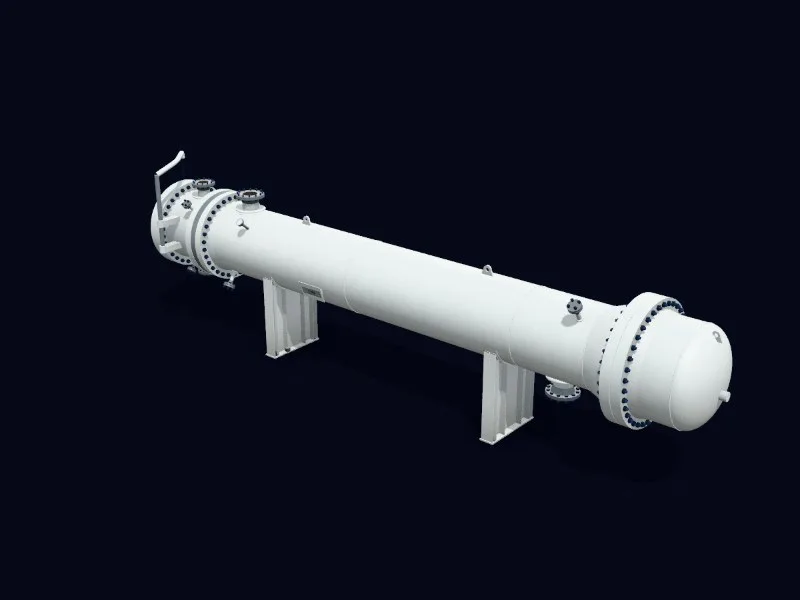
It is a shell-and-tube heat exchanger described by the TEMA three-letter code. The first letter is the front head, the second is the shell and the third is the rear head. An AES exchanger has a channel with a removable cover, a one-pass shell and a floating head. The shell-and-tube exchanger shows four common types in 3D.
What do the TEMA designation letters mean?
Each letter names one part of the exchanger. Front heads use A, B, C, N and D. Shells use E, F, G, H, J, K and X. Rear heads use L, M, N, P, S, T, U and W. The table above lists the common ones.
What is the Tubular Exchanger Manufacturers Association?
TEMA is a trade association of shell-and-tube heat exchanger manufacturers, based in the United States. It writes and sells the TEMA Standards. It now names editions by year: the 2026 edition followed the Eleventh Edition of 2024. Deck Twin does not supply the standards.
What are the TEMA standards?
They are the standards of the Tubular Exchanger Manufacturers Association for shell-and-tube heat exchangers. They define the three-letter type designation, the construction Classes R, C and B, fabrication tolerances and the mechanical rules for tubes, baffles and tubesheets. The pressure parts are designed to a pressure vessel code as well.
What is TEMA Class R?
Class R is the TEMA construction class for the generally severe duty of petroleum and related processing. It is the class oil and gas purchasers normally specify, and API 660 uses it as its base. Classes C and B cover general commercial duty and chemical process service.
How do I read a TEMA size and type such as 23-192 AES?
23 is the nominal shell inside diameter in inches and 192 is the nominal tube length in inches, here 16 ft. AES is the type: an A front head (channel with removable cover), an E one-pass shell and an S floating head with a backing device.
Does TEMA cover heat exchanger thermal design?
Only in part. TEMA is mainly a mechanical standard, though it includes thermal relations, fluid property data and guidance on fouling. The thermal sizing of an exchanger is normally done with specialist software, and TEMA then sets how the chosen design is built.
In Deck Twin
The shell-and-tube exchanger takes a tema prop of AES, AEU, BEM or AKT (kettle), plus passes, stacked, diameter and length. Its shell wall comes from shellThickness with the pressure prop, and its nozzles from ASME B16.5. The hairpin exchanger also cites TEMA. The geometry is generic and not a thermal or mechanical design.
Deck Twin uses these standards as reference values for visualisation. Check the current edition of each standard before using any value for design, procurement or fabrication.