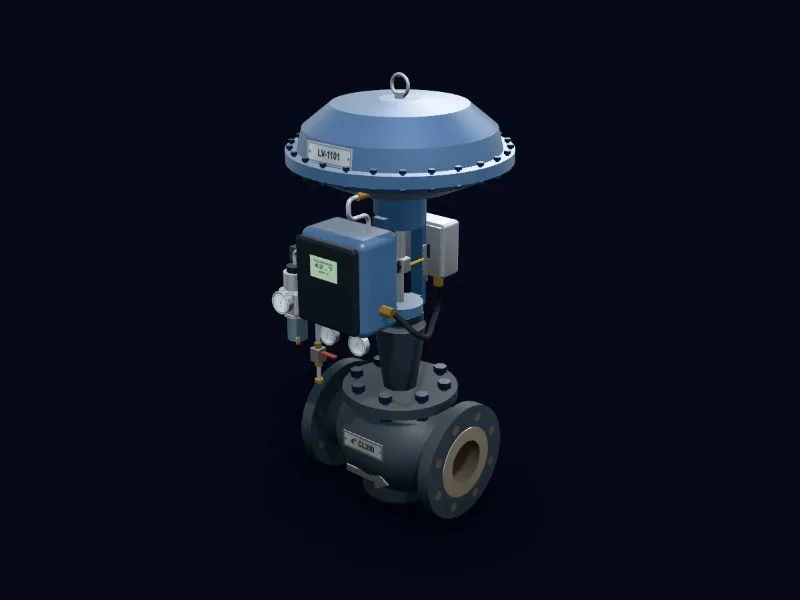
ISA 75.08.01
Face-to-face dimensions for flanged globe control valves
ISA 75.08.01 sets face-to-face dimensions for flanged globe control valve bodies, so valves from different makers fit the same piping.
Scope
ANSI/ISA-75.08.01 sets the face-to-face dimensions of integral flanged globe-style control valve bodies over the lower pressure classes, up to Class 600. Other parts of the ISA 75.08 series cover flangeless, butt-weld and higher-class bodies, and IEC 60534-3 covers the same subject internationally.
On oil and gas facilities it lets piping designers lay out control valve stations before a valve maker is chosen, and lets a valve be replaced by another maker's without changing the piping. It applies to the level, pressure, flow and temperature control valves throughout the process.
It does not cover valve sizing, trim, actuators, leakage class or noise. Sizing follows ISA 75.01.01 or IEC 60534-2-1, and the full valve is defined on its datasheet.
Key concepts
- Face-to-face
- Face-to-face is the distance between the two flange faces of the valve body. Fixing it by size and class makes bodies interchangeable.
- Globe bodies
- A globe control valve throttles flow with a plug moving against a seat. The body shape is longer than a gate valve of the same size, so it has its own dimension table.
- Pressure classes
- Dimensions are set by nominal size and flange class. Higher classes need longer bodies because the flanges are thicker.
- Control valve station
- A control valve is usually installed with block valves on each side, a bypass and drains. The fixed face-to-face lets the station be designed early.
- Actuator and positioner
- The actuator and positioner sit above the body and are not covered. Their height and clearance must still be allowed for in the layout for maintenance access.
Questions
What is ISA 75.08.01?
ANSI/ISA-75.08.01 is the standard that fixes the face-to-face dimensions of flanged globe-style control valve bodies in the lower pressure classes, up to Class 600. Valves from different makers then fit the same gap in the piping.
What does face-to-face mean for a control valve?
It is the distance between the two flange faces of the valve body, measured along the pipe. A piping designer uses it to set the length of the spool pieces on each side of the valve.
Is ISA 75.08.01 the same as ASME B16.10?
No. ASME B16.10 gives face-to-face dimensions for manual valves such as gate, globe, check and ball valves. Globe control valves have their own, different lengths in ISA 75.08.01 and in IEC 60534-3-1.
Which standard covers higher pressure classes?
Flanged globe control valves in Classes 900, 1500 and 2500 are covered by another part of the series, ISA 75.08.06. Butt-weld and flangeless bodies have their own parts too.
In Deck Twin
faceToFace('control-globe', nps, rating) in lib/standards/valves.ts returns the flanged globe control valve face-to-face in metres. Class 900 and above are approximate values in the style of the higher-class part of the series. The control valve uses it, with nps, rating and open for stem travel, and adds a diaphragm actuator, positioner and filter-regulator. Values are reference values for visualisation, not for procurement.
import { faceToFace } from './components/deck-twin/lib/standards'

faceToFace('control-globe', 4, 300)  // 0.368
faceToFace('control-globe', 2, 150)  // 0.254
Deck Twin uses these standards as reference values for visualisation. Check the current edition of each standard before using any value for design, procurement or fabrication.