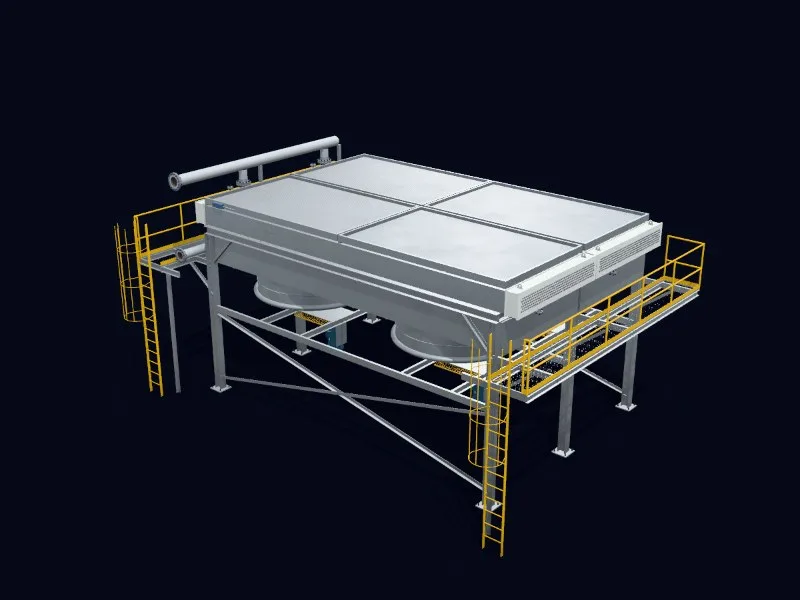
API 661
Air-cooled heat exchangers
API 661 air coolers explained: forced and induced draft, tube bundles and plug or cover plate headers, fans, and how it relates to ISO 13706.
Scope
API 661 gives requirements for the design, materials, fabrication, inspection, testing and preparation for shipment of air-cooled heat exchangers for the petroleum, petrochemical and natural gas industries. It covers the tube bundles and headers, the fans and drives, the structure, the plenums and the louvres, and accessories such as walkways and access.
On oil and gas facilities air coolers cool gas after compression, condense overhead vapours, and cool lube oil, produced water and closed-loop cooling medium. They are common onshore and in dry areas where cooling water is scarce. Offshore they are less common, because seawater is at hand and deck space is costly, but they are used on some platforms and FPSOs.
ISO 13706 is the related international standard. The thermal design method is not set by API 661, and the pressure parts are designed to a pressure vessel code, usually ASME Section VIII. Shell-and-tube exchangers are covered by API 660.
Forced draft and induced draft
| Forced draft | Induced draft | |
|---|---|---|
| Fan position | Below the bundle, blowing air up through it | Above the bundle, drawing air up through it |
| Access | Fans and drives near grade, easy to reach | Fans and drives above the bundle |
| Air distribution | Less even, and exposed to sun and rain | More even, and the plenum shields the bundle |
| Hot air recirculation | More likely, because the exit air is slow | Less likely, because the exit air is faster |
| Use | The more common type | Chosen where recirculation or weather protection matters |
A general comparison, not a copy of the standard.
Header types
The header is the box at each end of the bundle that distributes the fluid into the tubes. In a plug header, the most common type, each tube has a threaded plug opposite it in the outer plate. A plug is removed to clean or plug that tube, without opening the whole header.
In a cover plate header the outer plate is bolted on with a gasket and can be taken off to reach all the tubes at once. It suits fouling services and lower pressures. Very high pressures can need other header forms, such as headers built from pipe.
Edition
The current API 661 is the 7th edition of July 2013, reaffirmed in 2024. The current ISO 13706 is the 2011 edition, last confirmed in 2023. Check both catalogues before you cite them.
Key concepts
- Bay and bundle
- A bay is one section of the cooler with its own fans. Each bay holds one or more tube bundles side by side. Coolers are sized by adding bays.
- Finned tubes
- Air carries heat poorly, so the tubes have thin aluminium fins wound or embedded on the outside to add surface. The fin type is chosen for temperature and for the corrosion conditions of the site.
- Fans and drives
- Axial fans with adjustable or auto-variable pitch blades are driven by electric motors, usually through belts or gearboxes. Variable speed drives or variable pitch control the cooling.
- Louvres
- Adjustable blades above or below the bundle that limit the air flow. They are used for control and to protect the process from overcooling in cold weather.
- Winterisation
- In cold climates, hot air recirculation, steam coils or louvres keep viscous liquids from freezing or waxing in the tubes.
- Tube passes
- The fluid can cross the bundle once or several times, with pass partitions in the headers. More passes raise the velocity and the heat transfer.
Questions
What is API 661?
API Standard 661 is the specification for air-cooled heat exchangers in petroleum, petrochemical and natural gas service. It sets the minimum requirements for the bundles, headers, fans, drives and structure. The current edition is the 7th, from 2013, reaffirmed in 2024.
What is the difference between forced draft and induced draft air coolers?
In a forced draft cooler the fans sit below the tube bundle and push air through it. In an induced draft cooler the fans sit above and pull air through. Forced draft is more common and easier to maintain, and induced draft gives more even air flow with less hot air recirculation.
What is the difference between API 661 and API 660?
API 661 covers air-cooled exchangers, which reject heat to the air with fans. API 660 covers shell-and-tube exchangers, which exchange heat between two fluids. Both are purchase specifications used with a pressure vessel code.
In Deck Twin
The air-cooled exchanger cites API 661 and ISO 13706. It takes bays, fansPerBay, tubeLength, bayWidth, rows, passes, a forced or induced draft, louvres and a plug or cover-plate header, with nozzle flanges from ASME B16.5. The geometry is generic. It is not a thermal or mechanical design and has not been checked against API 661.
Deck Twin uses these standards as reference values for visualisation. Check the current edition of each standard before using any value for design, procurement or fabrication.