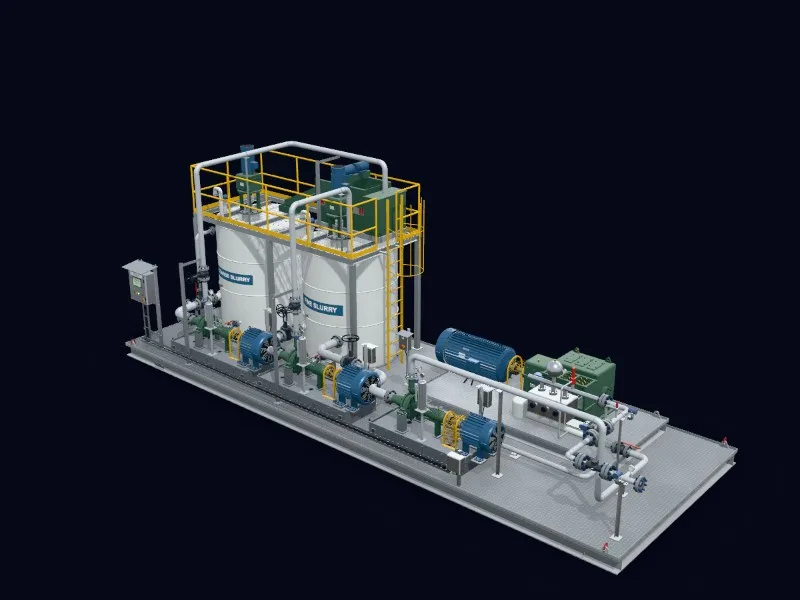
API 674
Positive displacement pumps: reciprocating
API 674 reciprocating plunger pumps explained: power and liquid ends, flow pulsation, suction pressure, relief, and how API 674 compares with 675 and 676.
Scope
API Std 674 specifies reciprocating positive displacement pumps: power pumps driven through a crankshaft, and direct-acting pumps. It covers the power frame, liquid end, valves, packing, pulsation suppression, relief, testing and the skid.
On oil and gas facilities these pumps deliver high pressure at modest flow: glycol circulation, methanol injection, high-pressure water and chemical injection, well testing, and cuttings or waste re-injection. Drilling mud pumps are similar machines, and their fluid-end components are covered by API 7K.
Controlled-volume metering pumps are covered by API 675, and rotary positive displacement pumps by API 676.
What API 674 covers
API 674 is the API standard for reciprocating positive displacement pumps in petroleum, petrochemical and gas service. It covers power pumps, where a motor or engine turns a crankshaft, and direct-acting pumps, where a steam or gas piston drives the liquid piston on the same rod. Controlled-volume pumps, hydraulically driven pumps and rotary pumps are outside its scope.
The current edition is the third, published in December 2010, with errata issued since. ISO 13710 covers the same kind of pump at international level, so check which one the project specification names. Like the other API machinery standards, API 674 is a purchase specification: it sets minimum requirements, and it comes with a data sheet that the purchaser and the vendor complete together.
- 1
Basic design
Selection of pump type, speed and pressure ratings, pressure-containing parts, piping loads, the liquid end, the power end running gear, direct-acting pumps, lubrication and materials.
- 2
Accessories
Drivers, couplings, belt drives, mounting plates, controls, auxiliary piping, and pulsation and vibration control.
- 3
Inspection and testing
Material inspection, hydrostatic and performance tests, and preparation for shipment.
- 4
Vendor's data and annexes
Proposal and contract data, then annexes on materials, pulsation control techniques, data sheets, NPSH and NPIP, and the lube oil system.
Inside a plunger pump
A power pump has two halves. The power end turns rotation into a straight push: the crankshaft drives a connecting rod, which drives a crosshead sliding in a guide. The liquid end does the pumping: the plunger moves in and out of a chamber, sealed by packing where it enters.
As the plunger draws back, the chamber grows, the suction valve opens and liquid flows in. As it pushes in, the suction valve shuts and the discharge valve opens once the chamber pressure rises above the line pressure. The pump delivers almost the same volume on every stroke, whatever the discharge pressure, which is why it suits high-pressure duty. See the plunger pump in 3D.
Why the flow pulses
Each plunger delivers only on its discharge stroke, so the flow from a single plunger comes in pulses with gaps between them. Three or five plungers, set at equal crank angles, overlap their pulses so the total flow ripples instead of stopping. This is why triplex and quintuplex pumps are the usual choice for continuous process duty.
The ripple that remains still shakes the piping. API 674 asks for pulsation and vibration control and describes the techniques in an annex: a suction stabiliser and a discharge dampener close to the pump and, on larger systems, an acoustic study of the connected piping. API 688, the standard for pulsation and vibration control in positive displacement machinery, now covers API 674 pumps as well.
API 674, API 675 and API 676 compared
These three standards split positive displacement pumps by how they move the liquid, and they are easy to mix up. API 675 covers metering pumps, such as the diaphragm metering pump. API 676 covers rotary pumps, such as the progressive cavity pump. Centrifugal pumps follow API 610.
| Standard | Machine | How the flow is set | Typical duty |
|---|---|---|---|
| API 674 | Reciprocating power pumps (plunger or piston) and direct-acting pumps | Fixed volume per stroke; flow changes with speed or a bypass | High pressure at low to moderate flow: glycol, high-pressure water, well service, cuttings re-injection |
| API 675 | Controlled-volume (metering) pumps with a packed plunger or diaphragm liquid end | Stroke length or speed adjusted to set a small flow precisely | Chemical injection: corrosion inhibitor, methanol, biocide, demulsifier |
| API 676 | Rotary positive displacement pumps: screw, gear, lobe, vane and progressive cavity | Fixed volume per revolution, with no valves and a smooth flow | Viscous crude and fuel oil transfer, lube oil systems, oily sludge |
A general summary for orientation. The scope of each standard is set in its current edition.
Suction pressure and acceleration head
A reciprocating pump starves more easily than a centrifugal pump. On every suction stroke the liquid in the suction line has to speed up and slow down again. The pressure used to accelerate it, called acceleration head, is lost from the pressure available at the pump inlet.
Acceleration head grows with the length of the suction line, the liquid velocity and the pump speed, and it falls as the number of plungers rises. The usual cures are a short, large-bore suction line, a suction stabiliser, a charge pump, or a lower pump speed.
API 674 uses both net positive inlet pressure (NPIP), the margin above vapour pressure at the pump inlet expressed as a pressure, and net positive suction head (NPSH), the same margin expressed as a head of liquid. An annex explains how the two relate.
The pump in its system
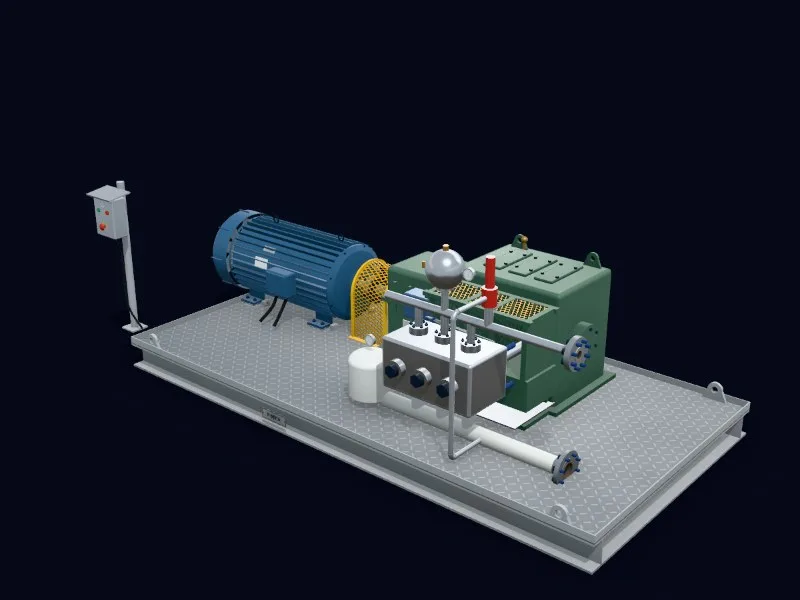
An API 674 pump is never installed on its own. A typical skid carries a suction strainer and stabiliser, the pump and its motor (often through a gear unit or belt drive), a discharge dampener, a relief valve back to suction or to a safe place, and a bypass used to start the pump unloaded.
Flow is usually set by a variable speed drive on the motor or by returning part of the flow through a bypass. A positive displacement pump keeps raising the pressure against a closed valve until something gives, so the relief valve must stay in service whenever the pump runs. On the waste injection skid a high-pressure plunger pump drives cuttings slurry down a disposal well.
Checklist for an API 674 pump
- 1
Rated and relief pressure
Set the rated discharge pressure and the relief valve set pressure, and check that the power end and the liquid end are rated for the relief case.
- 2
Speed
The standard limits speed for continuous service. A lower speed gives longer valve and packing life, at the cost of a larger pump.
- 3
Suction margin
Check the NPIP or NPSH available against the pump requirement, including acceleration head, at the worst operating case.
- 4
Pulsation
Agree who carries out the pulsation study, how deep it goes, and where the stabiliser and dampener sit.
- 5
Liquid end
Choose materials, plunger coating and packing for the liquid, and say whether the packing needs flushing.
- 6
Tests
Agree the hydrostatic and performance tests, any optional tests, and which of them are witnessed.
Key concepts
- Plunger count
- Pumps are described by the number of plungers: simplex, duplex, triplex or quintuplex. More plungers give a smoother flow with less pulsation for the same rate.
- Power end and fluid end
- The power end holds the crankshaft, connecting rods and crossheads. The fluid end holds the plungers, packing and suction and discharge valves, and is the part that sees full discharge pressure.
- Pulsation dampers
- Each stroke pulses the flow, so suction stabilisers and discharge dampers are fitted close to the pump. Larger systems get an acoustic study of the connected piping.
- NPSH and acceleration head
- The suction must supply enough pressure for the liquid to follow the plunger without vaporising. Acceleration of the liquid column adds a demand that centrifugal pumps do not have, so suction lines are kept short and large.
- Discharge relief
- A positive displacement pump keeps pushing against a closed valve until something fails. A relief valve on the discharge, often returning to suction, is essential.
Questions
What is an API 674 pump?
It is a reciprocating positive displacement pump built to API Standard 674. Most are power pumps: a motor or engine turns a crankshaft, which drives plungers or pistons through crossheads. They are used where high pressure is needed at a low or moderate flow. The plunger pump is a 3D model of one.
Which API standard covers reciprocating pumps?
API 674 covers reciprocating pumps. API 675 covers controlled-volume metering pumps, and API 676 covers rotary pumps such as screw, gear and progressive cavity pumps. Centrifugal pumps follow API 610.
What is the difference between API 674 and API 675?
An API 674 pump moves a fixed volume per revolution, so its flow is changed by speed or by a bypass. An API 675 pump is a metering pump: its stroke can be adjusted to set a small flow precisely, and the standard sets accuracy limits. High-pressure transfer and injection duties use API 674, and chemical dosing uses API 675.
What is the difference between a plunger pump and a piston pump?
In a plunger pump a smooth plunger slides through packing that stays still in the stuffing box. This suits high pressure. In a piston pump the seal rings move with the piston inside a liner. This suits larger flows at lower pressure, as in a drilling mud pump.
What is the latest edition of API 674?
The third edition, published in December 2010, is the current base edition, with errata issued since. Check the API catalogue or a standards reseller for the latest errata before you cite it.
What is the difference between API 674 and API 676?
API 674 covers reciprocating pumps, which use plungers or pistons with suction and discharge valves. API 676 covers rotary positive displacement pumps, such as screw, gear, vane and progressive cavity pumps, which have no valves and give a smoother flow. Rotary pumps suit viscous liquids at moderate pressure, while API 674 pumps reach higher pressures. See the progressive cavity pump.
Does API 674 cover direct-acting steam pumps?
Yes. Both direct-acting and power-frame pumps are in scope. In a direct-acting pump a steam or gas piston on the same rod drives the liquid piston, with no crankshaft. Controlled-volume pumps and hydraulically driven pumps are not covered.
In Deck Twin
The plunger pump takes plungers (3 or 5), kw, nozzle sizes, a suctionRating and a discharge rating up to Class 2500, and draws the power frame, fluid end, suction stabiliser, discharge dampener and relief valve back to suction. The waste injection skid uses a high-pressure plunger pump for cuttings re-injection. Motors come from iecMotor and flanges from flange. The proportions are generic.
Deck Twin uses these standards as reference values for visualisation. Check the current edition of each standard before using any value for design, procurement or fabrication.