API 675
Positive displacement pumps: controlled volume (metering)
API 675 metering pumps explained: controlled-volume dosing pumps for chemical injection, diaphragm and plunger liquid ends, accuracy, and API 675 vs 674.
Scope
API Std 675 specifies controlled-volume pumps, also called metering or dosing pumps, whose flow is set by varying the effective stroke length. It covers the drive, the liquid end, stroke adjustment, accuracy, materials, testing and the accessories around the pump.
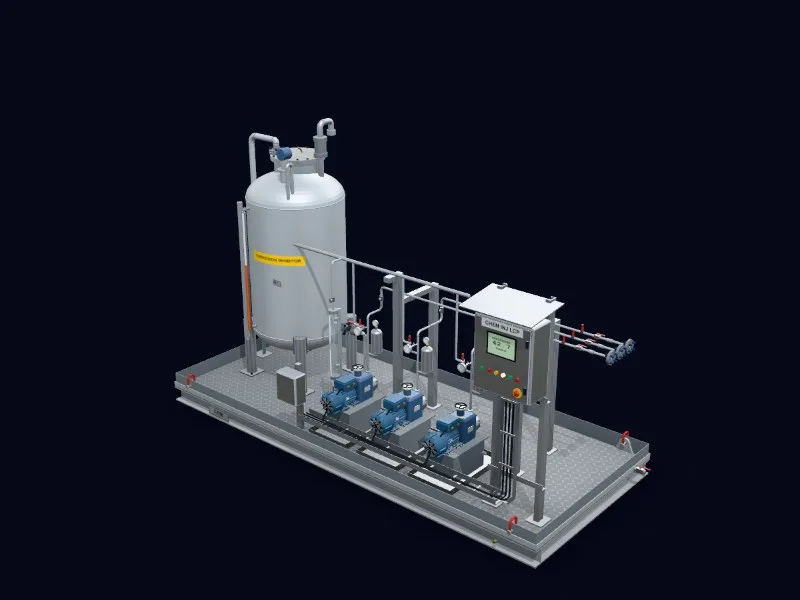
On oil and gas facilities these pumps inject chemicals at small, steady rates: corrosion and scale inhibitor, demulsifier, antifoam, biocide, methanol and oxygen scavenger. They are usually grouped on a chemical injection skid with storage tanks and calibration pots.
Larger reciprocating pumps are covered by API 674 and rotary pumps by API 676. The injection quills, check valves and tubing downstream are part of the plant piping.
Key concepts
- Stroke adjustment
- Flow is set by changing the effective stroke length, manually with a micrometer adjuster or with an electric or pneumatic actuator. The pump delivers a fixed volume per stroke at a given setting.
- Liquid end types
- A packed plunger pumps the liquid directly. A hydraulically actuated diaphragm liquid end separates the process liquid from the plunger, which moves the diaphragm through a hydraulic fluid, so the chemical cannot leak past packing. Diaphragms driven directly by a mechanical linkage are outside the scope of API 675.
- Accuracy and turndown
- The standard sets limits for steady-state accuracy, repeatability and linearity over the turndown range. Exact figures must be taken from the current edition and the pump datasheet.
- Check valves
- Suction and discharge check valves, often double ball, control the flow on each stroke. Their condition is the most common cause of lost accuracy.
- Accessories
- A metering pump system usually has a calibration pot on the suction, a pulsation damper, a back-pressure valve and a relief valve on the discharge.
Questions
What is an API 675 pump?
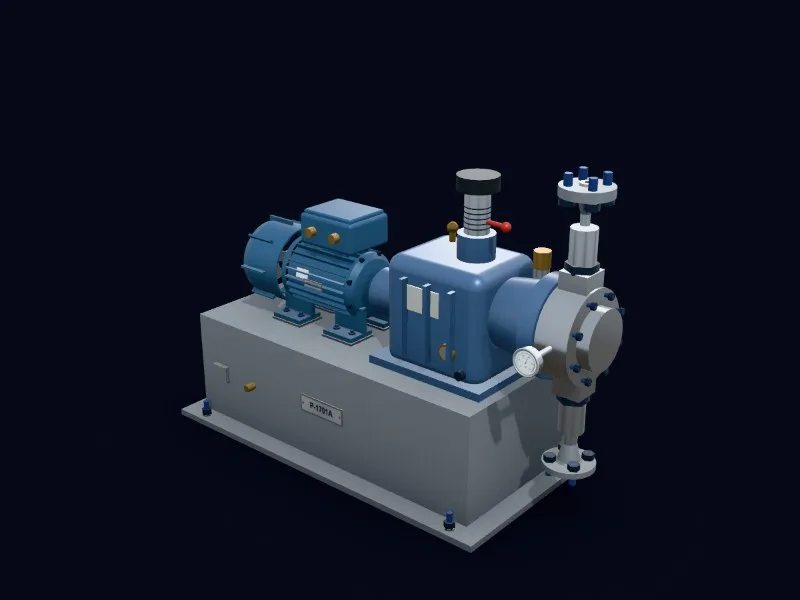
It is a controlled-volume pump, also called a metering or dosing pump, built to API Standard 675. It is a reciprocating pump whose delivered volume can be set precisely by varying the effective stroke length. On oil and gas facilities it injects chemicals such as corrosion inhibitor and methanol. See the diaphragm metering pump and the chemical injection skid.
Does API 675 cover diaphragm pumps?
Yes. It covers hydraulically actuated diaphragm liquid ends as well as packed plunger liquid ends. A double diaphragm design has two diaphragms with a monitored space between them, so a failed diaphragm is found before the chemical leaks. Air-operated double diaphragm pumps are a different kind of machine and are not API 675 pumps.
What is the difference between API 675 and API 674?
API 675 is for metering pumps with adjustable, accurate flow at small rates. API 674 is for larger reciprocating plunger and piston pumps that deliver a fixed volume per revolution at high pressure.
In Deck Twin
The diaphragm metering pump takes nozzle sizes, a suctionRating, a discharge rating up to Class 2500, kw and a stroke setting that moves the adjuster. It draws a hydraulically actuated diaphragm head with double-ball check valves. The chemical injection skid combines several pumps (pumps) with a tank and an outlet header. Motors come from iecMotor and flanges from flange. The proportions are generic.
Deck Twin uses these standards as reference values for visualisation. Check the current edition of each standard before using any value for design, procurement or fabrication.