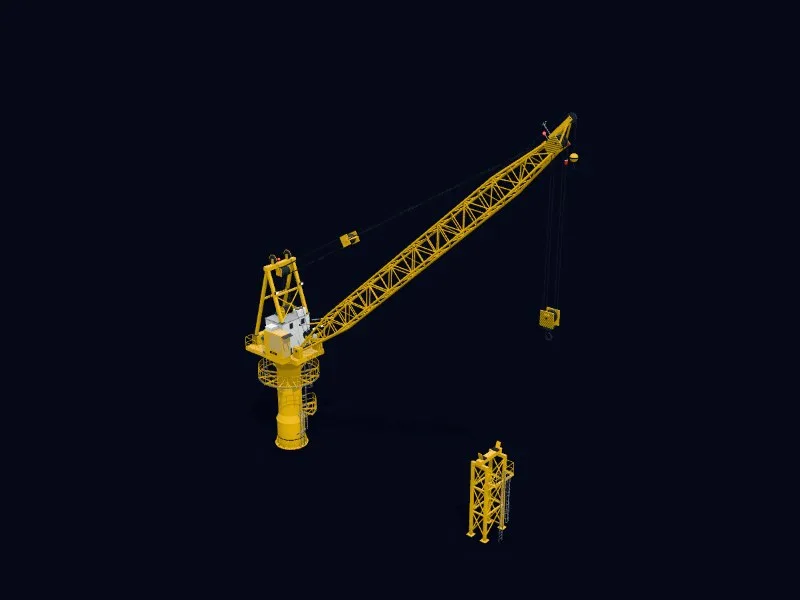
API Spec 2C
Offshore pedestal-mounted cranes
API Spec 2C covers offshore pedestal cranes: dynamic factors for sea lifts, load charts, wire rope reeving, slew bearings and overload protection.
Scope
API Spec 2C specifies the design, construction and testing of pedestal-mounted cranes used on fixed and floating offshore platforms, drilling rigs and vessels. It covers the structure, slew bearing, machinery, wire rope reeving, load ratings and the safety devices.
On an offshore platform, pedestal cranes lift containers, baskets and equipment between the deck and supply vessels, and handle loads around the deck. Each crane has load charts for lifts on board and lifts to and from a moving vessel.
Operation, inspection and maintenance are covered by API RP 2D. EN 13852-1 is the European standard for offshore cranes, and certification bodies such as DNV publish their own rules.
Key concepts
- Onboard and offboard lifts
- An onboard lift moves loads around a fixed deck. An offboard lift picks loads from a moving supply vessel, so the crane sees extra dynamic load and its rating is lower.
- Dynamic factors
- The design load for offboard lifts is increased by a dynamic factor that depends on the significant wave height and the relative motion of the boat and the crane. This is why load charts are given for several sea states.
- Slew bearing
- The large bearing between the pedestal and the crane carries all the overturning moment. It and its bolts are critical items with their own design margins and inspection regime.
- Wire rope and sheaves
- Sheave and drum diameters are set as a ratio to the rope diameter to limit bending fatigue. Reeving and rope safety factors depend on the line pull and whether the lift carries personnel.
- Overload protection
- Cranes are fitted with a rated capacity indicator and, offboard, with overload protection that lets the hook pay out if a load snags on a departing vessel. The failure sequence is designed so that the pedestal and slew bearing are not the first parts to fail.
Questions
What is API Spec 2C?
API Specification 2C is the standard for the design, construction and testing of pedestal-mounted cranes on offshore platforms, rigs and vessels. It defines how a crane is rated for lifts on the deck and for lifts from a moving supply vessel. The offshore pedestal crane is a 3D model of the type.
Is it API Spec 2C or API RP 2C?
The crane design standard is a specification: API Spec 2C. The recommended practice is API RP 2D, which covers the operation, inspection and maintenance of offshore cranes. The two are used together, so people often mix up the names.
In Deck Twin
The offshore pedestal crane is a diesel-hydraulic lattice-boom crane with boomLength, slew, luff, hook, pedestalHeight, swl and an optional boomRest. The library sets sheave pitch diameters at 18 times the rope diameter or more, and draws the slew bearing, winches, A-frame, luffing tackle, LMI load cell and anti-two-block switch. It does not produce a load chart or a structural design. Cargo baskets and shipping containers are typical loads.
Deck Twin uses these standards as reference values for visualisation. Check the current edition of each standard before using any value for design, procurement or fabrication.